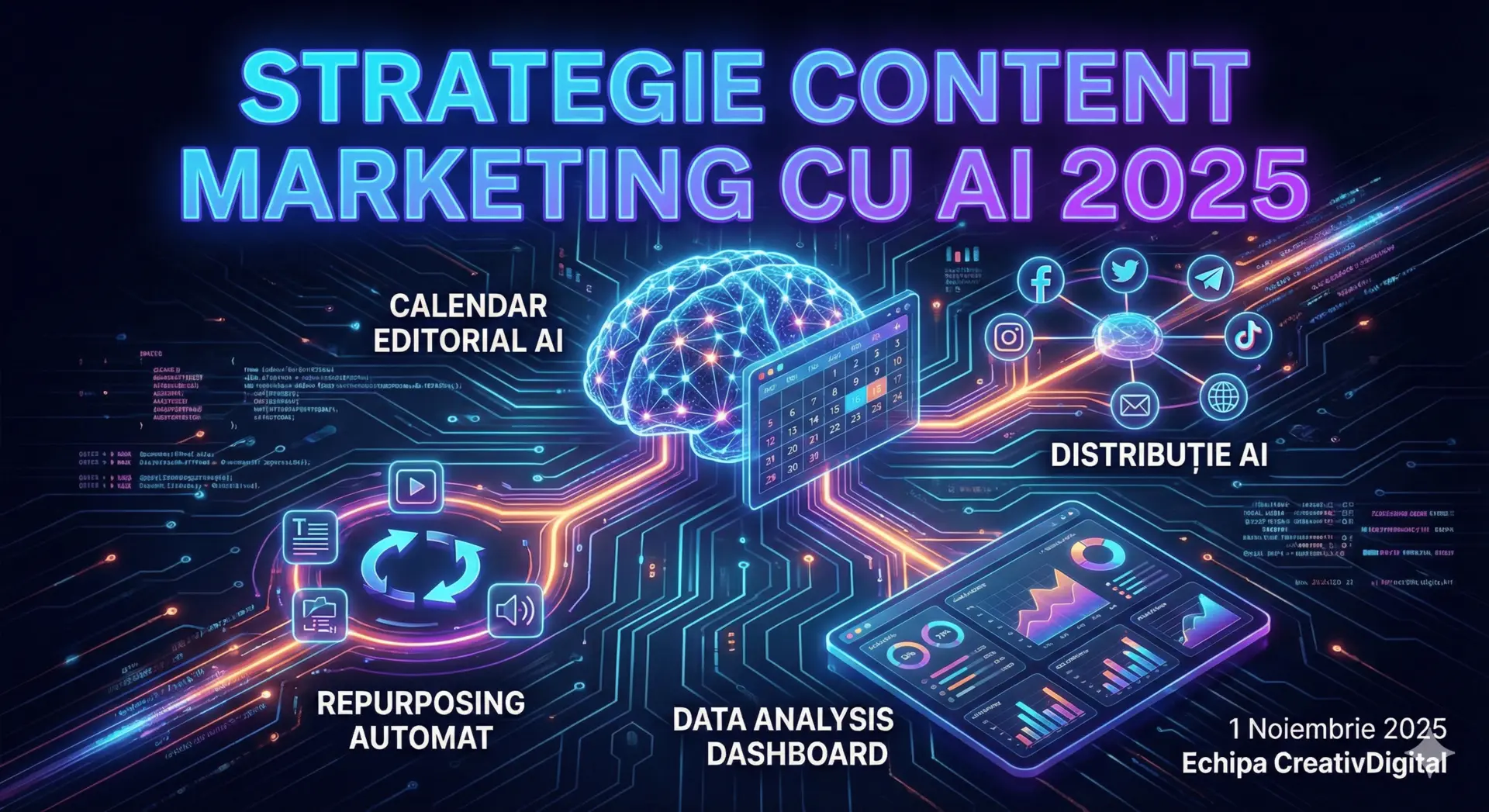
Content marketing in 2026 faces a scaling paradox: teams must produce more content, more personalized content, and content for more channels, while operating with the same resources or even fewer. Artificial intelligence does not solve quality by itself, but it transforms content operations: it accelerates research, automates repetitive tasks, and enables repurposing at scale. This guide presents the full CreativDigital framework for an AI-first content marketing strategy, validated in B2B and B2C programs.
Executive Summary
- +180% content volume growth without increasing team size
- 70% time reduction for research and briefing
- 5x repurposing: one article becomes 15+ assets across channels
- Quality maintained: editorial review processes and E-E-A-T compliance
1. RESEARCH & DISCOVERY - Finding Winning Topics
The first step is identifying topics that combine market demand, audience relevance, and alignment with business goals.
1.1. Multi-Source Consolidation
We aggregate data from 5 source categories:
- Search Console & Ahrefs: high-impression, low-CTR queries = content opportunities
- Customer voice: questions from support tickets, sales calls, onboarding sessions
- Social listening: LinkedIn, Reddit, niche forums for real pain points
- Competitor analysis: gap analysis against top 3 competitors (what they cover, what they miss)
- Trend signals: Google Trends, industry reports, conference themes
1.2. AI-Powered Topic Clustering
We use LLMs to group thousands of queries and feedback points into semantic clusters:
- Export data: 5,000-50,000 terms from keyword research + customer feedback
- Embeddings: convert terms to vectors with OpenAI Ada or Cohere
- Clustering: K-means / DBSCAN to identify thematic pillars
- Topic naming: LLM summarizes each cluster and suggests article titles
- Intent mapping: automated classification (informational, commercial, transactional)
1.3. Scoring & Prioritization
Our scoring model combines 4 factors:
| Criterion | Weight | Data Source |
|---|---|---|
| Search demand | 30% | Ahrefs volume + trend |
| Business alignment | 30% | Manual scoring (1-5) |
| Content gap | 25% | Competitor coverage analysis |
| Ranking difficulty | 15% | Domain Rating, SERP competitiveness |
Output: a prioritized list of 50-100 topics for the next 6-12 months.
2. CONTENT PILLARS & EDITORIAL CALENDAR
2.1. Defining Pillars (3-5 major pillars)
Pillars are the central themes of the content strategy, aligned with:
- Product/service lines: each pillar reflects a product or solution category
- Customer journey stages: awareness, consideration, decision, retention
- Strategic priorities: expansion into new markets, upsell, thought leadership
Example for a B2B SaaS marketing platform:
- Pillar 1: Marketing Automation (10-15 articles, target: awareness + consideration)
- Pillar 2: Data & Analytics (10-15 articles, target: consideration + decision)
- Pillar 3: AI in Marketing (10-15 articles, target: thought leadership)
2.2. Topic Matrix & Sub-Topics
Each pillar is broken down into 10-15 sub-topics mapped by:
- Format: long-form article, how-to guide, checklist, case study, comparison
- Funnel stage: TOFU (awareness), MOFU (consideration), BOFU (decision)
- Content type: evergreen vs timely, foundational vs advanced
2.3. Automated Editorial Calendar
We use AI for intelligent scheduling:
- Seasonality detection: AI analyzes historical trends and suggests timing
- Balance enforcement: balanced distribution across pillars and funnel stages
- Dependency tracking: foundational articles published before advanced content
- Editorial calendar integration: Notion, Airtable, Monday, CoSchedule
3. CONTENT PRODUCTION - AI + Human Hybrid
3.1. Brief Generation (80% AI, 20% Human)
For each calendar topic we auto-generate a brief:
GPT-4o prompt:
Analyze top 10 SERP results for "[KEYWORD]" and generate a JSON content brief:
- Target keyword + LSI variants
- Search intent (informational/commercial/transactional)
- Audience persona and pain points
- H2/H3 structure based on SERP analysis
- Questions to answer (PAA + Related Searches)
- Unique angle (what is missing from current SERP)
- Target word count
- Sources for citations
- Internal linking opportunities
- Recommended CTA
Human review: a specialist validates the brief, adjusts the angle, and adds proprietary perspectives.
3.2. Draft Production (70% AI, 30% Human)
Production runs in 4 stages:
- AI draft (1-2 hours): LLM generates full draft from the brief
- Expert input (2-3 hours): specialist adds unique insights, proprietary data, case studies
- Fact-checking (1 hour): source verification and claim cross-referencing
- Optimization (1 hour): Surfer SEO / Clearscope for on-page, readability, internal linking
3.3. Quality Gates
| Gate | Validation | Owner |
|---|---|---|
| Factual accuracy | Every claim has supporting sources | Subject Matter Expert |
| E-E-A-T | Author bio, credentials, original research | Editorial Lead |
| Brand voice | Tone, terminology, message consistency | Content Strategist |
| SEO compliance | Title, meta, headings, schema, internal links | SEO Specialist |
| Legal/compliance | Verifiable claims, disclaimers | Legal (when required) |
4. REPURPOSING & DISTRIBUTION - 1 Article = 15+ Assets
4.1. Content Atomization Framework
From each long-form article (2,000-3,000 words) we automatically generate:
Social Media (7-10 assets)
- LinkedIn: 3-4 posts (carousel, text-only, poll, video teaser)
- Twitter/X: 5-7 tweets (thread with key takeaways)
- Instagram/Facebook: 2-3 quote cards + short video
Email Marketing (2-3 assets)
- Newsletter feature: summary + CTA to full article
- Drip campaign: split into 3-5 emails with progressive insights
- Lead magnet: downloadable PDF checklist or framework
Video & Audio (2-3 assets)
- Short-form video: 60-90 second key takeaway (TikTok, Reels, Shorts)
- Podcast snippet: 5-10 minute audio discussion (Spotify, Apple Podcasts)
- Webinar slides: 15-20 slide presentation deck
Internal Tools (2-3 assets)
- Sales enablement: one-pager for the sales team
- Customer success: FAQ or onboarding how-to
- Product marketing: feature announcement template
4.2. Automation Workflow
We orchestrate repurposing with:
- LangChain / Make: automated workflow to generate derivative assets
- Canva API: auto-generate visuals and quote cards
- Descript / Pictory: text-to-video for short-form content
- Distribution automation: scheduling in Buffer, Hootsuite, Later
5. DISTRIBUTION & AMPLIFICATION
5.1. Owned Channels
- Blog: publish with schema markup, internal linking, related content
- Email: segment-based distribution (persona, funnel stage, engagement level)
- Social: multi-platform distribution with channel-specific timing
- Community: Slack, Discord, Circle content seeding with relevant context
5.2. Earned & Paid Amplification
- PR & outreach: pitch to relevant publications
- Influencer seeding: share with industry micro-influencers
- Paid social: boost top-performing content with dark posts
- Native advertising: Outbrain, Taboola for extended reach
5.3. SEO Distribution Layer
- Internal linking: automated links to/from related articles
- Link building: outreach for high-quality backlinks
- Content syndication: Medium, LinkedIn Articles with canonical strategy
- Community seeding: Reddit, Quora, niche forums (value-first, no spam)
6. MEASUREMENT & OPTIMIZATION
6.1. Content Performance Metrics
| Metric | Benchmark | Tool |
|---|---|---|
| Organic traffic | +30% MoM after 3 months | GA4 + GSC |
| Engagement rate | > 60% scroll depth | GA4 + Hotjar |
| Conversion rate | 2-5% (TOFU), 5-10% (MOFU), 10-20% (BOFU) | GA4 + CRM |
| Share of voice | +20% vs competitors in 6 months | Semrush, Ahrefs |
| Backlinks earned | 5-10 per major article | Ahrefs, Majestic |
| Social engagement | 3-5% engagement rate | Native analytics |
6.2. Predictive Content Analytics
We use ML models for:
- Traffic forecasting: estimate future traffic from historical data + SERP trends
- Content decay detection: identify pages losing rankings
- Refresh recommendations: when and how to update existing content
- Topic opportunity scoring: identify high-potential new topics
6.3. Content Refresh Automation
The refresh program includes:
- Quarterly review: audit content published in the past 12-24 months
- AI analysis: identify content gaps, outdated data, broken links
- Refresh brief: AI generates update brief by section
- Expert update: specialist applies updates + new insights
- Republish: update
dateModified, redistribute across channels
7. GOVERNANCE & QUALITY CONTROL
7.1. Editorial Guidelines
Mandatory team documentation:
- Brand voice guide: tone, terminology, do's and don'ts
- AI usage policy: where and how AI is used, disclosure requirements
- Fact-checking protocol: claim verification process
- SEO standards: title, meta, schema, linking requirements
- Legal compliance: disclaimers, attribution, permissions
7.2. Human-in-the-Loop Workflow
| Stage | AI Role | Human Role | Quality Gate |
|---|---|---|---|
| Research | Topic clustering, data aggregation | Prioritization, strategy | Topic approval |
| Briefing | Brief generation | Validation, angle adjustment | Brief sign-off |
| Draft | Initial draft (70-80%) | Expert input, fact-check | Editorial review |
| Optimization | SEO recommendations | Implementation, internal linking | SEO QA |
| Repurposing | Asset generation | Curation, quality review | Brand review |
| Distribution | Scheduling, automation | Personalization, timing | Final approval |
8. CASE STUDY - B2B SaaS Marketing Platform
Context
Challenge: B2B SaaS company with a small team (1 content marketer, 2 freelance writers), 150+ article backlog, and no systematic process.
Implemented Solution
- AI research & clustering: 50,000 keywords → 3 pillars, 45 prioritized topics
- Brief automation: 80% of briefs auto-generated, 20 min review per brief
- Hybrid production: AI draft + expert review, article time reduced from 3 days to 8 hours
- Repurposing workflow: 1 article → 15 assets automatically (social, email, video)
- Distribution automation: orchestrated publishing + amplification
Results After 6 Months
- Volume: from 6 articles/month to 25 articles/month (+317%)
- Assets generated: 375 social posts, 75 email campaigns, 50 video snippets
- Organic traffic: +124% (from 15K to 33K visitors/month)
- MQL generated: +89% qualified leads from content
- Cost efficiency: -42% cost per piece vs full outsourcing
- Quality maintained: stable engagement rate (65% average scroll depth)
9. RECOMMENDED TOOL STACK
Research & Strategy
- Ahrefs / Semrush: keyword research, competitor analysis
- Google Search Console: performance data, query insights
- AnswerThePublic / AlsoAsked: question mining
- SparkToro: audience research, influencer identification
Production & Optimization
- GPT-4o / Claude 3.5: brief generation, draft production
- Surfer SEO / Clearscope: content optimization
- Grammarly / Hemingway: editing, readability
- Copyscape / Originality.AI: plagiarism and AI detection
Repurposing & Distribution
- Canva / Figma: visual asset creation
- Descript / Pictory: video generation
- Buffer / Hootsuite: social scheduling
- HubSpot / Marketo: email automation
Analytics & Optimization
- Google Analytics 4: traffic, engagement, conversion
- Hotjar / Clarity: heatmaps, session recordings
- Looker Studio / Tableau: dashboards and reporting
- ContentKing / Oncrawl: content performance monitoring
10. IMPLEMENTATION ROADMAP (90 days)
Sprint 1 (Days 1-30): Foundation & Research
- Audit existing content + competitive analysis
- Set up tool stack (APIs, integrations, workflows)
- Run research & topic clustering for 50-100 topics
- Define pillars and Q1 editorial calendar
- Train the team on AI tools and processes
Sprint 2 (Days 31-60): Production & Optimization
- Pilot 8-10 articles with AI-assisted workflow
- Implement quality gates and editorial guidelines
- Set up repurposing automation (social, email, video)
- Distribute on owned channels + test paid amplification
- Build measurement framework and dashboards
Sprint 3 (Days 61-90): Scale & Iterate
- Scale to 15-20 articles/month
- Full repurposing: 15+ assets per article
- Optimize based on performance data
- Launch refresh program for older content
- Add predictive analytics for topic opportunities
Conclusion
Content marketing in 2026 requires an AI-first approach to stay competitive. This framework combines intelligent automation with human expertise, enabling teams to produce high volumes of quality content, repurpose efficiently, and distribute strategically across channels.
Keys to success:
- AI is an amplifier, not a replacement for human expertise
- Quality gates and editorial review are non-negotiable
- 1:15 repurposing maximizes ROI for every article
- Continuous measurement and data-driven optimization are essential
Want to implement an AI-first content marketing program? That is exactly what our content marketing service delivers: strategic consulting, tool stack setup, team training, and operational support for scaling your content engine. Book a consultation to discuss your goals.