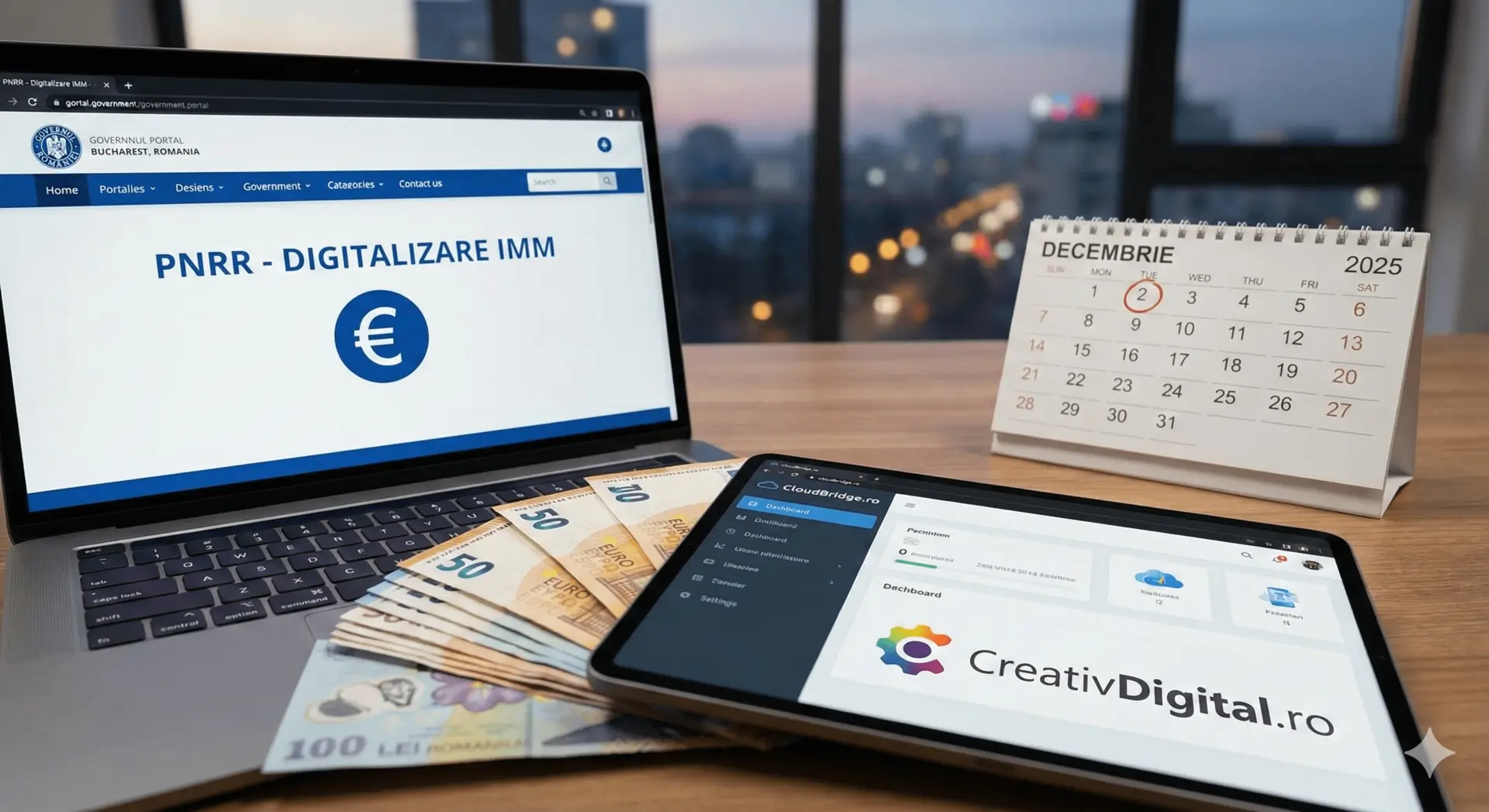
It is 2025. If you run a business in Romania, your inbox is probably full: consultants promising miracle outcomes, ads for software that supposedly does everything, and headlines about billions of euros from PNRR waiting to be spent.
On paper, it sounds like a promised land. Everyone talks about SME digitalization, grants, POCIDIF and C9 funding lines. Amounts like EUR 30,000, 50,000 or even 100,000 in non-reimbursable funding are compelling. For many companies, this can mean the difference between stagnation and real growth.
But let us talk honestly about the real feeling behind it.
Under the excitement, there is pressure: fear of bureaucracy, confusing documentation, hard deadlines and expensive decisions made under stress.
Because "free money" comes with serious accountability. What if you choose the wrong vendor? What if the purchased software does not fit operations? What if an audit in 3 years asks for reimbursements because certain DESI indicators were not actually achieved?
This is not a sales pitch. It is a practical conversation from one business team to another about how to navigate this landscape and end with a genuinely stronger company, not just spent grant budget.
We are the team behind CreativDigital.ro and CloudBridge.ro, and this is how we see implementation in the field.
The "Panic Buying" Trap: Why Off-the-Shelf Software Can Hurt You
Typical scenario: you sign the funding contract, project budget is approved, and the implementation clock starts immediately.
Time pressure pushes teams toward fast purchases. A famous ERP brand appears "safe," so you buy quickly to move the file forward.
Pause first.
Digitalization is not license procurement. Digitalization means changing how people actually work.
When you buy standard software, you buy someone else's assumptions about your business model. It is one-size-fits-all tailoring. Maybe acceptable short term, costly long term.
The better question is: why adapt your company to rigid software when funding can support software adapted to your process?
At Creativ Digital, we favor custom software for this reason. Your internal workflows, edge cases and operating logic are business assets. Standard products often flatten them. Custom systems can automate them.
PNRR funding can finance this strategic advantage: map your workflows, design architecture around real process needs, then build exactly what your business requires.
Think about the details that make your operations unique:
- how internal approvals actually happen;
- how procurement and supplier handoffs are managed in the real world;
- how your team handles urgent exceptions that no generic workflow predicts.
Those details often define margin and execution speed. If software ignores them, teams fall back to manual workarounds and scattered spreadsheets. You do not get real digitalization; you get a new layer of friction.
DESI Criteria: From Fear Factor to Strategic Ally
Yes, grant language can be technical and abstract. Everyone talks about DESI indicators and digital intensity scoring.
In practice, these criteria ask for very concrete outcomes:
- reduce paper/manual process dependency;
- increase data integrity and operational traceability;
- modernize the way you sell and deliver value.
A practical interpretation is simple: evaluators want evidence that your company can operate faster, safer and more predictably after project completion. Hardware or licenses alone rarely prove this. Process redesign + adoption + measurable KPIs usually do.
"I need a website." No, you need a revenue engine.
Many companies say: "We got a grant, we need a EUR 5,000 website." This is usually an under-ambitious interpretation.
At Creativ Digital, we treat this budget line as a business growth lever, not a checkbox.
- build a B2B portal where clients see live stock and place self-service orders;
- build an integrated eCommerce flow connected to inventory and shipping generation.
That is real digitalization. And yes, it can be fully eligible when scoped correctly.
Cloud computing: the invisible foundation
Another frequent confusion: "Cloud required" is interpreted as simple file storage.
Cloud is much more than that. It is the foundation under every mission-critical software flow.
Here our colleagues at CloudBridge.ro are essential.
Cloud architecture done right means:
- secure workloads on AWS/Azure/private cloud;
- automatic backup and recoverability in ransomware scenarios;
- scalable infrastructure that can absorb demand spikes without service collapse.
And these infrastructure components can support both compliance outcomes and DESI scoring when implemented with traceable governance.
If the software layer is what users see, cloud is the structural layer underneath:
- identity and access control;
- backup and retention policy;
- uptime monitoring and alerting;
- disaster recovery procedures tested before incidents happen.
Without this foundation, a project can look good in presentations but fail under real operational stress.
From Vendor Relationship to Real Implementation Partnership
Let us be direct: the market has opportunistic providers chasing grant budgets. Some disappear after advance payment. Others deliver low-value outputs that leave you exposed at audit time.
Our teams at CreativDigital and CloudBridge are built for long-term delivery, not one-off grant transactions.
We understand the practical pressure founders face after contract signature:
- "Can we implement on time?"
- "Will this stand up to audit?"
When we work together, we take part of that implementation burden:
- we review your funding application and obligations;
- we design technical scope to match commitments precisely;
- we deliver software + cloud infrastructure aligned with declared objectives;
- we support technical documentation required for reimbursement and audit flows.
Why this model? Because your success compounds ours. If your systems produce measurable business improvement, the partnership continues.
We also know that founders often carry implementation anxiety alone. A serious technical partner should reduce that burden through transparent milestones, explicit ownership and documented decisions.
A Practical Note on Ownership
Here is a crucial point often ignored in grant sales conversations.
With large off-the-shelf subscriptions, after the monitoring period ends, budget is gone but recurring license dependency remains. Stop paying, lose capability.
With custom software built under your funded project:
- budget converts into a company asset;
- solution logic is tailored to your operation;
- strategic dependency on external licensing decisions is reduced.
You are not renting your future operating model. You are building it.
This ownership angle matters after the monitoring period ends. Companies that invested in tailored systems usually keep more control over roadmap, integrations and long-term cost structure.
2025 Moves Fast. What Should You Do Next?
European projects run on strict timelines. Building robust software and migrating infrastructure takes planning, analysis, validation and staged rollout.
Do not leave implementation for the last quarter and then buy whatever is available under pressure.
Use this period to make quality decisions: architecture first, compliance by design, adoption planning early.
If useful, we can review your project scope together in a direct working session: no sales theater, just technical and operational decisions that improve project outcomes.
Practical next-day checklist
- Re-read approved commitments line by line.
- Separate business-critical outcomes from checkbox deliverables.
- Map dependencies between software, infrastructure and operating teams.
- Define adoption metrics before implementation starts.
- Track reimbursement documentation in parallel with technical delivery.
Teams that execute this checklist early usually avoid deadline panic, scope confusion and expensive late-stage procurement mistakes.
Ready to Execute Differently?
If the answer is yes:
- for software and implementation strategy, see our custom software development service or contact CreativDigital;
- for automation with AI, read our PNRR digitalization funding guide and see autonomous AI agents;
- for infrastructure, resilience and cloud operations, connect with CloudBridge.ro.
Turn grant bureaucracy into long-term operating advantage.
When approached correctly, funding does not just buy tools. It upgrades the way your company executes.