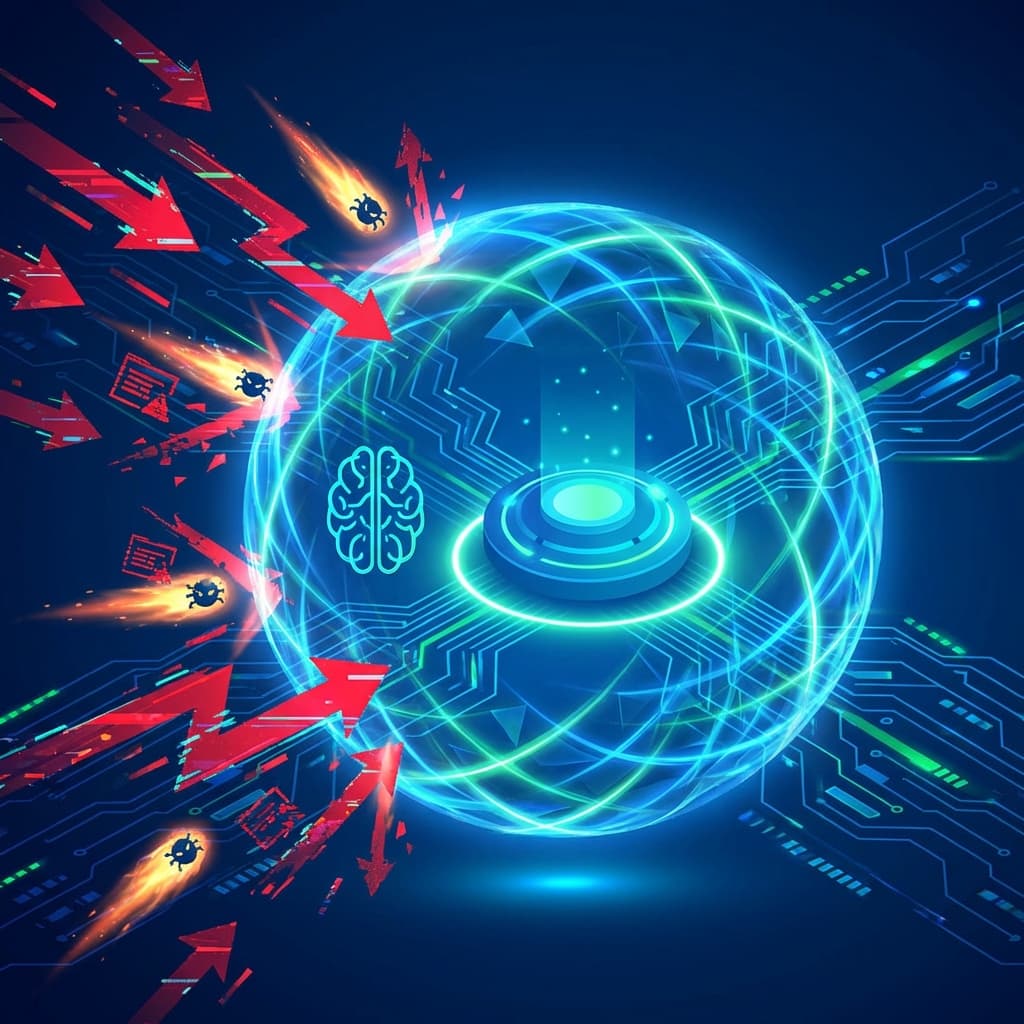
In 2026, the old saying "it is not a matter of if you get attacked, but when" is already outdated. The reality is harsher: organizations are being probed continuously.
With autonomous offensive AI tools available cheaply in underground markets, companies of all sizes face constant automated reconnaissance. Attackers do not sleep; their agents run 24/7.
The only viable response is moving from reactive security (classic firewall + endpoint antivirus mindset) to preemptive defense.
Executive summary
- Reaction speed collapsed: average time from infection to ransomware encryption fell dramatically. Human-only response is too slow.
- Identity is the new perimeter: most major breaches involve compromised credentials or identity abuse.
- Regulatory pressure is rising: AI-related governance and security accountability requirements are expanding.
1. 2026 threat landscape: top attack vectors
1.1 Hyper-personalized spear phishing
Attack agents harvest open data (social profiles, public contacts, leaked datasets), then craft highly contextual phishing messages that mimic internal communication style.
Success rates are much higher than traditional generic phishing.
1.2 Deepfake vishing (voice/video impersonation)
Finance or operations staff receive realistic voice/video calls from fake executives requesting urgent transfers or sensitive actions.
1.3 Polyglot/adaptive malware
Modern malware can mutate behavior/signatures quickly, reducing effectiveness of static detection methods.
2. What preemptive defense means
Preemptive defense does not wait for damage confirmation. It predicts, detects and contains early.
Core pillars
- Attack Surface Management (ASM): continuous external/internal exposure discovery from attacker perspective.
- Predictive threat intelligence: signal correlation to detect likely campaigns before full execution.
- Deception mechanisms: honeypots and decoy assets to detect lateral movement early.
- Automated containment: fast isolation workflows triggered by confidence-based rules.
3. Zero Trust in AI-era operations
"Never trust, always verify" now requires continuous context checks, not only login controls.
3.1 Continuous behavioral authentication
Beyond credentials and MFA, systems monitor behavioral baselines:
- typing rhythm;
- interaction patterns;
- access timing anomalies;
- unusual data transfer behavior.
When behavior deviates materially, risk controls trigger step-up verification or access suspension.
3.2 Dynamic micro-segmentation
If one endpoint is suspected compromised, network policy narrows instantly around that asset. This limits lateral movement and blast radius.
4. Deepfake defense controls
How do you protect against fake executive calls?
- Content provenance standards (for example C2PA patterns): verify content origin integrity where platform support exists.
- Liveness detection checks: validate live-person signals for high-risk approvals.
- Challenge-response protocols: internal secret validation steps for sensitive requests.
- Dual-approval policy: critical financial actions require independent verification channels.
5. Security roadmap: building digital immunity
Preemptive defense is a program, not a one-time installation.
Phase 1: full visibility (Month 1)
- deploy endpoint telemetry (EDR/XDR) across managed assets;
- inventory all digital assets, including shadow IT.
Phase 2: identity hygiene (Month 2)
- enforce phishing-resistant MFA/passkeys for admins and sensitive roles;
- harden account lifecycle and privilege governance.
Phase 3: automation and resilience (Months 3-6)
- implement SOAR playbooks for repetitive incident workflows;
- integrate deepfake-aware controls in collaboration channels;
- run adversarial simulation drills regularly.
Phase 4: governance and continuous adaptation (Month 6+)
- define board-level security KPIs and review cadence;
- align security telemetry with business-risk ownership;
- re-tune detection models against new threat patterns quarterly.
6. 10-point 2026 security checklist
- Is phishing-resistant MFA (FIDO2/passkeys) enforced broadly?
- Are immutable backups tested monthly?
- Are source repositories scanned for secrets pre-merge?
- Is the incident response plan tested at least quarterly?
- Are teams trained for deepfake/social engineering recognition?
- Do you have full asset visibility (users, endpoints, services)?
- Are critical systems segmented from general network zones?
- Are security logs analyzed continuously with automated triage?
- Do you have a clear internal policy for AI tool usage?
- Is cyber-insurance aligned with current risk profile?
7. Conclusion
Cybersecurity in 2026 is not just a department function. It is an operating model.
In an AI-driven threat environment, business continuity depends on your ability to predict and contain attacks before they become incidents.
Preemptive defense is no longer an advanced option. It is baseline security engineering.
The organizations that treat security as continuous system design, not annual compliance paperwork, will be the ones that preserve trust, uptime and operating momentum.
CreativDigital provides cybersecurity services — penetration testing, security audits and Zero Trust architecture consulting. Start with a free assessment to see where your defenses stand.