The era of infinite scroll on small screens is nearing its end. As Extended Reality (XR) devices mature and smart glasses adoption accelerates, e-commerce is entering its largest shift since the smartphone.
Welcome to Spatial Commerce.
This guide details technologies, strategies, and practical implementation steps through which brands can adopt 3D spatial selling and remain relevant.
Executive summary
- Conversion lift: stores with 3D/AR experiences often report significantly higher conversion than static 2D product pages.
- Lower returns: realistic in-space visualization can reduce return rates substantially.
- Engagement increase: time spent on immersive product pages is typically multiple times higher.
1. What is Spatial Commerce?
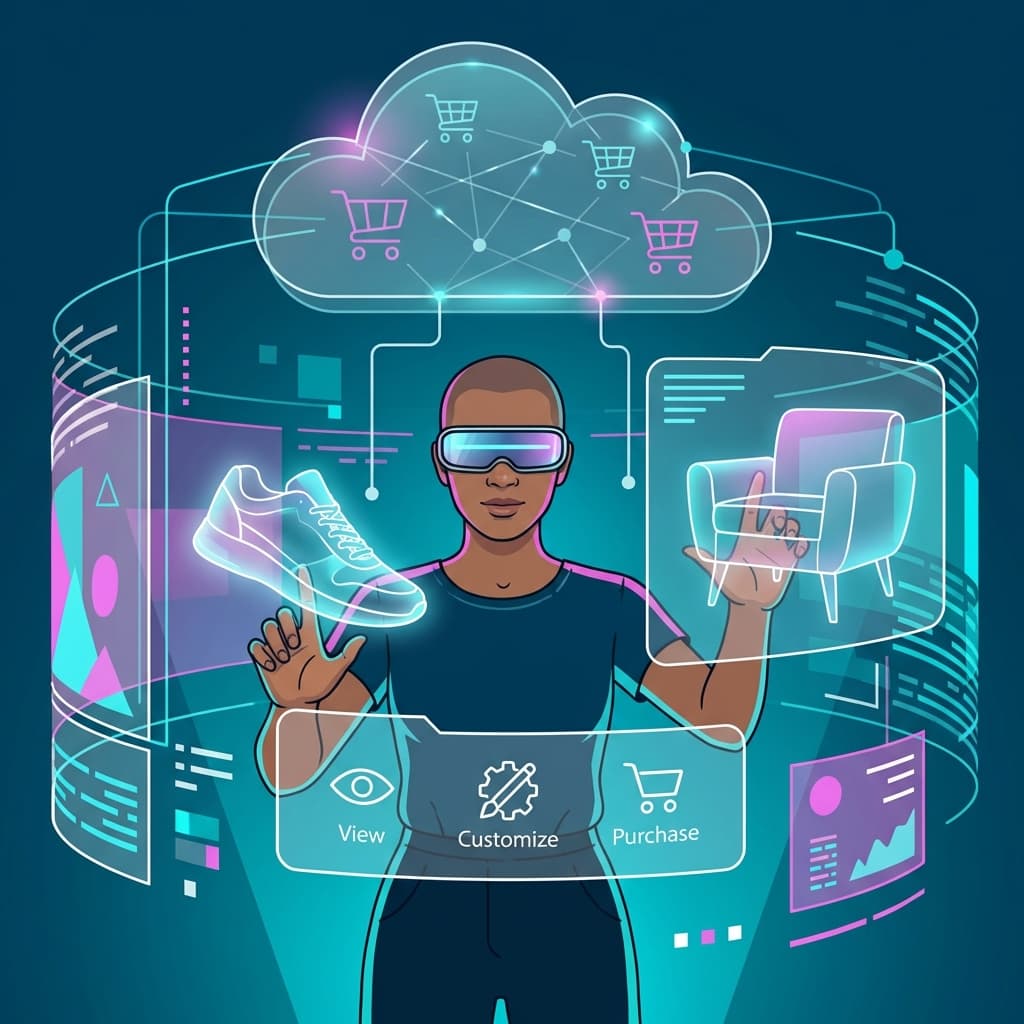
Spatial Commerce is the intersection between e-commerce and immersive technologies (AR, VR, MR). It is not only about rotating 3D models on white backgrounds. It is about bringing the store into the customer's environment, or bringing the customer into the brand's environment.
1.1. Three interaction modes
- Augmented Reality (AR): overlay digital products on the real world (for example try-on via mobile camera).
- Virtual Reality (VR): full immersion in a digitally rendered store/showroom.
- Mixed Reality (MR): persistent interaction between digital and physical objects.
2. Technology stack: from Web2 to Web3D
To deliver immersive experiences directly in browser without forcing app installs, use open standards.
2.1. 3D file formats
- glTF / GLB: open web standard for compact 3D delivery.
- USDZ: essential format for Apple ecosystem and visionOS contexts.
2.2. WebXR and rendering engines
- Three.js / React Three Fiber: foundational web 3D rendering stack.
- 8th Wall / Niantic: advanced markerless web AR workflows.
- WebGPU: next-gen browser graphics stack with console-level potential.
3. Content strategy: digital twins
At the core of Spatial Commerce is the digital twin of your product. Traditional photography is no longer enough for immersive conversion experiences.
How we create digital twins in 2026
- Advanced photogrammetry: reconstruct geometry and texture from many source images.
- NeRFs (Neural Radiance Fields): AI-based photoreal 3D generation from short video captures.
- Gaussian Splatting: real-time rendering technique for complex scenes on mobile-capable hardware.
4. UX design in 3D space
Classic web design rules do not map directly to immersive space.
Core principles
- Scale and distance: products must appear at realistic 1:1 dimensions.
- Gesture-friendly interaction: virtual controls need larger hit areas and clear visual feedback.
- Spatial audio: directional sound cues can guide attention and improve immersion.
5. Optimization and spatial SEO
How to ensure your 3D commerce experience is fast and discoverable?
5.1. Performance
- LOD (Level of Detail): adaptive model complexity by distance.
- Texture compression: KTX2/WebP for high quality at lower transfer cost.
- Draco compression: strong geometry size reduction.
5.2. Visual search optimization
Modern search ecosystems increasingly parse 3D-related metadata:
- structured
Productschema with 3D model references - optimized file naming and descriptive attributes
- high-quality 2D thumbnails for discovery surfaces
6. Case-study patterns: where it wins
Fashion and luxury
Luxury brands build virtual flagship experiences where premium audiences interact with collections in immersive formats and purchase directly.
Home and decor
Furniture retailers reduce uncertainty by letting users scan rooms, preview products at real scale, and evaluate fit with realistic light/context.
7. 6-month implementation roadmap
Do not transform your full catalog in one sprint. Start strategically.
Month 1-2: Audit and pilot
- select top products with high return rates
- create high-quality 3D versions for pilot
Month 3-4: Integrate 3D viewer
- deploy 3D viewer in existing PDP
- activate mobile "View in AR" CTA
Month 5-6: Analyze and scale
- measure conversion and return impact
- if ROI is positive, scale using AI-assisted 3D pipelines
- begin mini VR showroom experiment for new collections
8. Conclusion
Spatial Commerce is not a temporary trend. It is the natural evolution of digital commerce toward immersive interfaces.
Your customers already live in a 3D world. Your store should too.
CreativDigital provides end-to-end services in 3D model pipelines, WebXR optimization, and immersive commerce implementation. If your store runs on Shopify or Magento, we integrate 3D viewers directly into product pages — and for discoverability, our e-commerce SEO service covers 3D model schema markup too. Contact us to bring future-ready retail experiences to your brand.