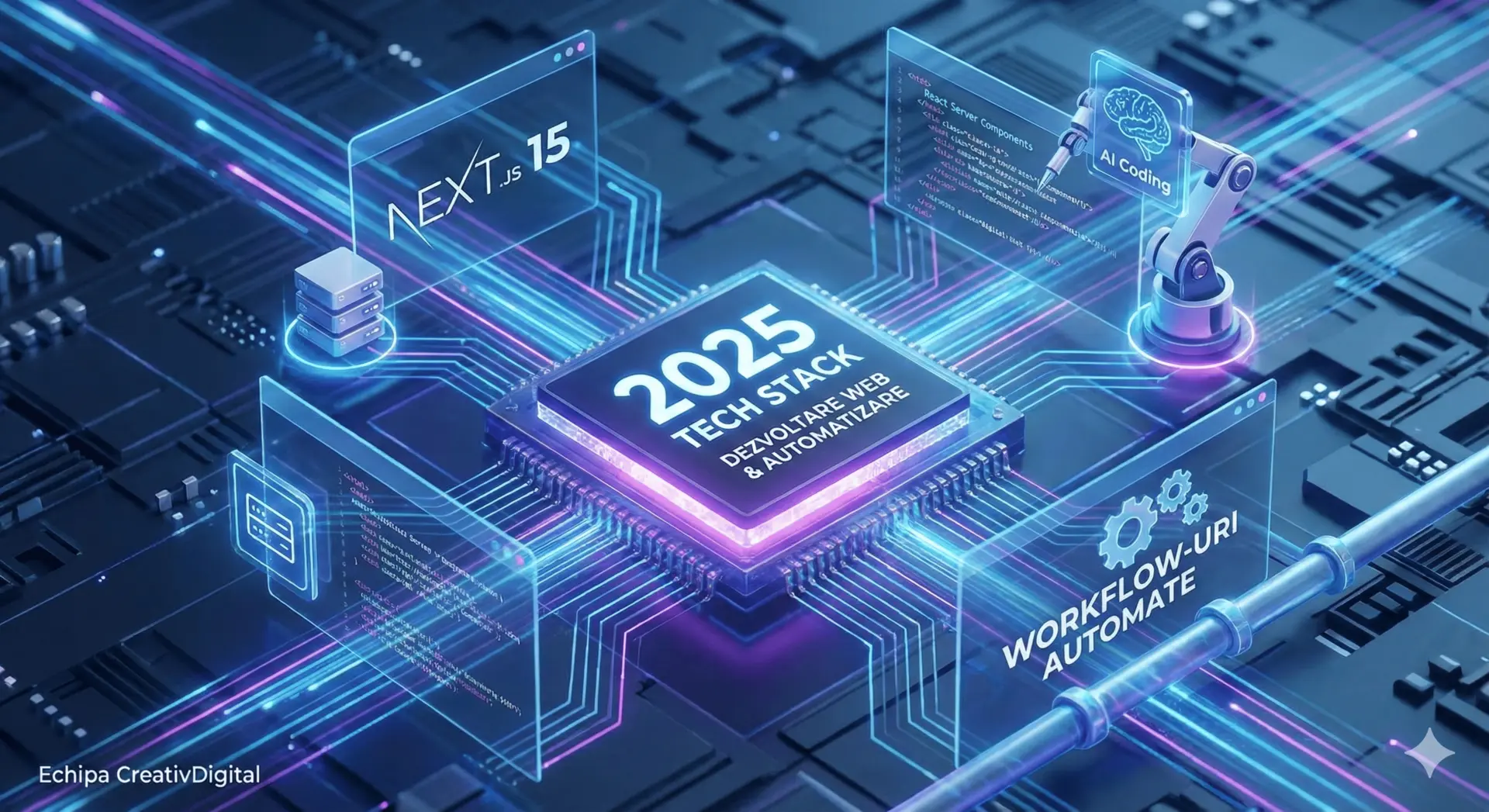
High-performing product companies and agencies can no longer rely only on individual effort. Web development automation reduces launch time, removes repetitive bugs, and builds a continuous feedback loop between business, design, and engineering.
This guide presents the full stack we use at CreativDigital for enterprise-scale delivery.
1. Modern reference stack
- Frontend: React 18 + Next.js 14/15, Astro for marketing pages, Storybook for UI consistency.
- Backend: Node.js/Express with serverless functions or NestJS; GraphQL/REST pipelines documented with OpenAPI.
- Data & cache: PostgreSQL, PlanetScale, Redis, edge KV.
- Infrastructure: Vercel, AWS, or Azure with IaC (Terraform, Pulumi).
2. Workflow automation framework
We implement a four-stage pipeline:
- Design to code: Figma → repository sync with tokens, Storybook, and visual snapshots.
- Branch automation: PR templates, semantic commits, rule engines for convention validation.
- Intelligent CI/CD: GitHub Actions + Turborepo + parallel test execution + preview environments.
- Release governance: feature flags, progressive rollout, end-to-end observability.
3. AI in web development
AI does not replace developers. It accelerates repetitive phases:
- Pair programming: GitHub Copilot / Cursor for fast scaffolding.
- Code review bots: custom rule systems (Danger, SonarQube, Graphite) for deviation alerts.
- Automated documentation: LLM-assisted design docs and changelog generation from repository context.
- Usage analytics: AI-based instrumentation for usage pattern detection.
4. Testing and quality engineering
Quality by design requires automation at every level:
- Unit/component tests: Vitest/Jest + React Testing Library + Storybook interactions.
- E2E: Playwright/Cypress on every PR with contract testing.
- Visual regression: Chromatic/Percy to prevent UI regressions.
- Performance budgets: Lighthouse CI thresholds before merge.
5. Observability and feedback
You cannot optimize what you do not measure:
- Logging and tracing: OpenTelemetry + Datadog/New Relic.
- RUM (Real User Monitoring): live Core Web Vitals tracking.
- Feature analytics: Mixpanel/Amplitude + Looker/Metabase dashboards.
- Incident management: PagerDuty + automated runbooks.
6. Developer productivity metrics
We use indicators aligned with Google DORA + SPACE frameworks:
| Metric | Target | Notes |
|---|---|---|
| Deployment Frequency | Daily / on-demand | Feature flags + trunk-based development |
| Lead Time for Changes | < 24h | Automated review + CI |
| Change Failure Rate | < 10% | Canary releases + observability |
| Mean Time to Recovery | < 1h | Automated rollback + runbooks |
7. Case study - B2B platform
Challenge: 15 developers, releases every 3 weeks, high bug backlog. After implementing the CreativDigital pipeline:
- +230% release frequency increase.
- -62% critical bug reduction.
- MTTR reduced to 35 minutes through observability and incident playbooks.
- Time-to-market for major features reduced to 2 weeks.
8. Maturity roadmap
- Phase 1 - Standardization: linting, formatting, automated testing, Storybook.
- Phase 2 - Automation: full CI/CD, preview environments, automated QA.
- Phase 3 - Observability: unified logs, RUM, alerting.
- Phase 4 - AI-assisted delivery: pair programming, automated review, documentation generation.
Want to implement the full pipeline? CreativDigital provides developer productivity audits, implementation support, and team training through our software development service. And if you want to automate business processes, not just the delivery pipeline, see our autonomous AI agents.