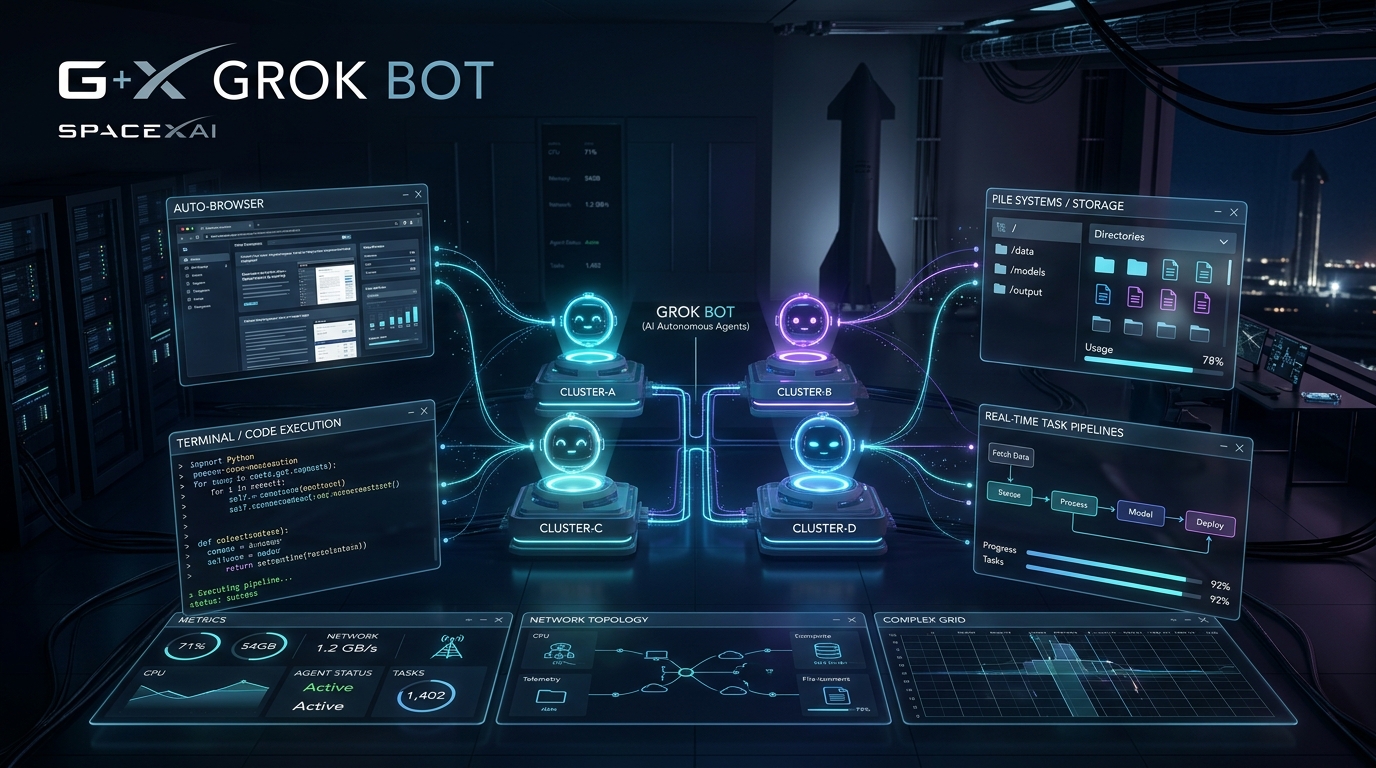
Grok Bot is SpaceXAI’s dedicated agent application that allows users to create, deploy, and manage multiple durable “Bots”—each equipped with a defined job, its own dedicated conversation thread, and a persistent working context that evolves over time.
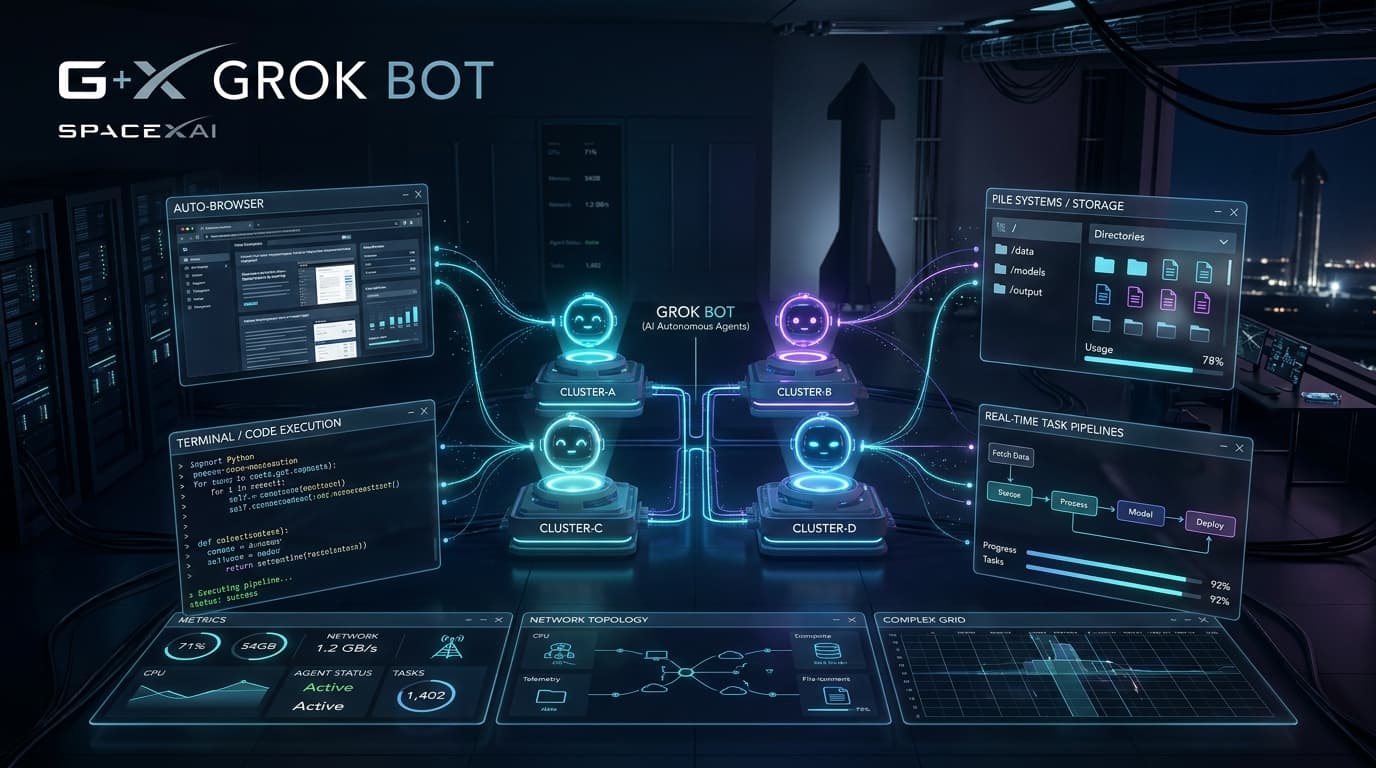
Rather than acting merely as a conversational chat window, every Bot runs on a dedicated cloud virtual machine powered by Linux, with an integrated web browser, file system, and terminal environment. This allows each agent to operate directly inside the everyday software and web applications the user already relies on.
These autonomous agents continuously execute tasks in the background and only return to the user when approval, clarification, or human judgment is explicitly required.
Context: From Grok the Chatbot to Grok Bot
Grok originated as xAI’s conversational model and chatbot, launched in 2023 and iterated through successive generations up to Grok 4.x, offering real-time web search, a deep-reasoning “Think” mode, image generation, and API access.
In August 2026, SpaceXAI (the division formed by folding xAI directly into SpaceX) introduced Grok Bot to shift the industry focus from merely “answering questions” to executing real digital work across software systems, leveraging autonomous agents capable of end-to-end task execution.
In this unified ecosystem:
- Grok remains the primary conversational and prompt layer;
- Grok Build serves as a specialized product focused on coding and terminal-centric engineering workflows;
- Grok Bot acts as the autonomous agent layer driving web and desktop applications on the user's behalf.
How the Cloud Computer Works
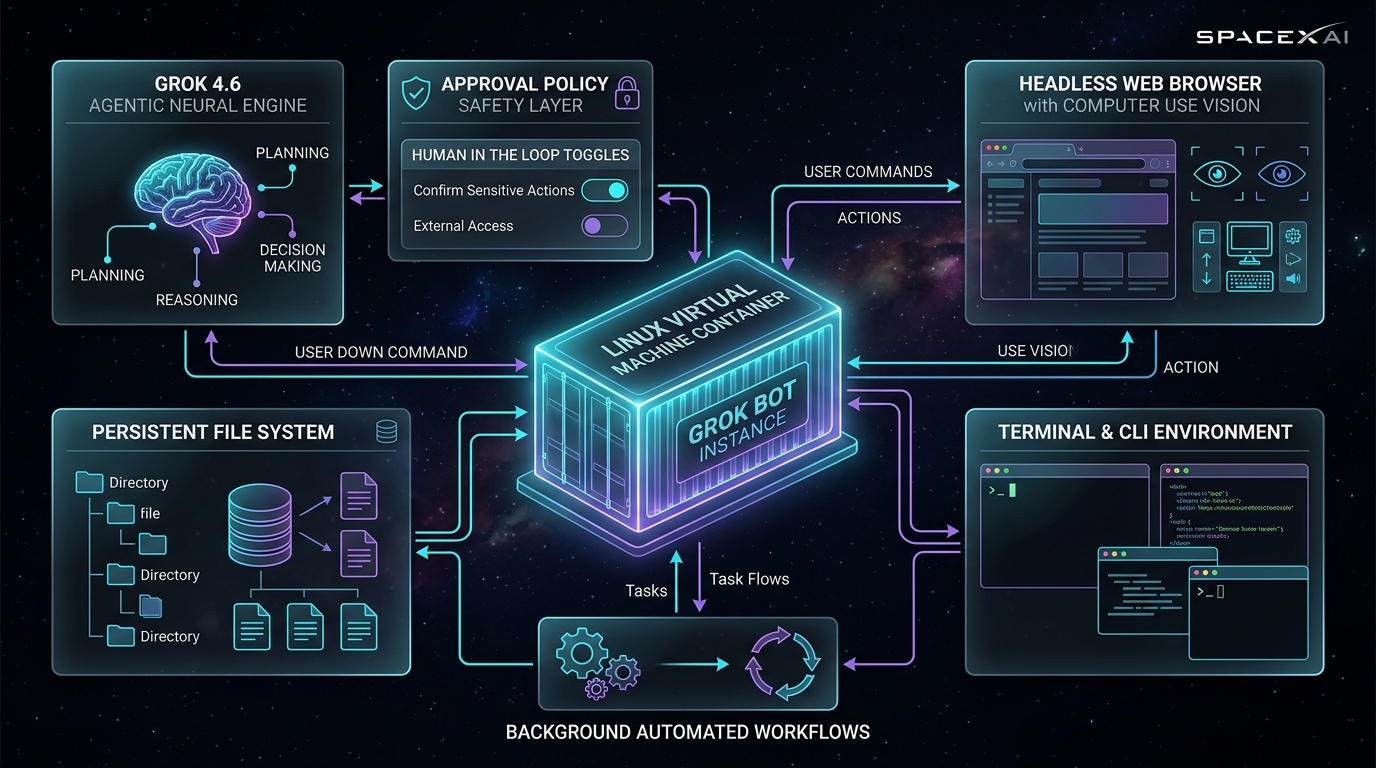
At an architectural level, each Grok Bot account is backed by a persistent cloud computer: a Linux virtual machine (VM) equipped with a headless browser, file system, and command-line terminal.
Bots interact with software through “computer use”: they visually analyze user interfaces (UI) via continuous screenshot loops and execute actions by clicking buttons, navigating pages, and typing into fields just like a human operator.
Because of this approach, Grok Bot can work inside virtually any browser-based application—including legacy software, proprietary internal tools, or services lacking public APIs—without requiring custom API connectors or backend integrations.
What Bots Do in Practice
Official documentation and real-world production deployments demonstrate that Grok Bot use cases concentrate across four primary domains: sales and growth, inbox and communication, customer support and operations, and product and engineering.
Most workloads follow a consistent automation loop: the Bot ingests data (emails, CRM records, files, or databases), applies predefined logic and validation heuristics, and writes the output—drafting an email, resolving a support ticket, producing a synthesized report, or updating records in a target system.
Common Real-World Use Cases
- Sales Prospector: Researches and enriches prospective accounts, drafts outbound messages matching the user’s personal tone, and keeps the CRM pipeline up to date.
- Inbox Manager: Performs daily email triage, drafts context-aware replies, and compiles executive morning summaries.
- Support Bot: Monitors the ticket queue, resolves common issues using the internal knowledge base, and escalates only edge cases to human specialists.
- Operations Bot: Automates refunds, performs recurring data reconciliations, and generates weekly operational summaries.
- Digital Chief of Staff: Coordinates multiple specialized Bots inside a shared channel, aggregating status updates and tracking cross-functional projects.
Creating and Managing Bots
According to official SpaceXAI documentation, a Bot is defined as a “durable AI teammate with a name, a job, its own conversation, and working context that develops over time.”
- Intuitive Setup: Users create a Bot in the Grok Bot application by selecting New → Create new agent, then customize it under Bot actions → Edit Profile (setting its name, role title, instructions, and avatar).
- Collaborative Channels: Each Bot maintains its own dedicated chat thread, but multiple Bots can be grouped into shared channels to coordinate and solve complex multi-agent workflows.
- High Capacity: A single account supports up to 50 combined Bots and group chats, enabling structured delegation across roles and projects.
- Seamless Sharing: Bots can be shared via direct links, allowing team members with eligible plans to import them directly into their own workspace.
Plans, Pricing, and Access
At its beta launch on August 11, 2026, Grok Bot was initially limited to SuperGrok Heavy, Cursor Ultra, and Cursor Teams Premium subscribers across desktop and iOS. Over subsequent weeks, access expanded to broader Cursor and SuperGrok plans, alongside limited-usage trial options.
Official Cursor billing documentation indicates that Grok Bot is included across all paid individual Cursor plans (Pro, Pro+, Ultra) and Cursor Teams seats, while individual SuperGrok accounts can be linked to supply additional compute usage.
Market analyses from ContinuumCode detail the following pricing tiers:
- Cursor Pro (~$20/month): AI-powered coding editor with foundational Grok capabilities.
- Cursor Pro+ (~$60/month): The most accessible documented individual tier with full Grok Bot integration.
- Cursor Ultra ($200/month): Flagship individual plan offering the highest compute allocation for intensive agent workflows.
- Cursor Teams Standard ($40/seat/month): Accessible entry point for small engineering and operations teams.
- Cursor Teams Premium (~$120/seat/month): Built for organizations running continuous autonomous agent workloads throughout the workday.
- SuperGrok Plus & Heavy (~$100 and ~$300/month): Dedicated individual tiers that include Grok Bot and link directly with Cursor accounts.
Key Takeaway: Grok Bot is not sold as an isolated standalone subscription—access is bundled within these ecosystem plans, with Bot usage metered separately from standard prompt interactions.
Relationship to Grok 4.6 and the API
Grok Bot’s launch is closely tied to Grok 4.6, introduced in August 2026 as an agent-grade foundation model optimized for complex planning, long-horizon tool use, and expansive context windows.
Grok 4.6 is accessible via Google Cloud Vertex AI and SpaceXAI’s direct API, offering context windows spanning hundreds of thousands of tokens at cost-effective rates per million input and output tokens. While Grok 4.6 supplies the underlying cognitive reasoning engine, the Grok Bot runtime manages orchestration, persistent state memory, and security guardrails.
Security Architecture: Shared Cloud Computer & Shared Credentials
The most critical operational consideration for Grok Bot is its shared machine security model.
All Bots created under a single account operate on the same persistent cloud computer: sharing a single browser cookie store, a unified filesystem, and a common set of terminal credentials.
SpaceXAI documentation explicitly cautions: “The screens are separate work surfaces, not separate security boundaries,” and “Do not use separate Bots as a security boundary.”
Practical Security Implications
- Shared Credential Visibility: A Bot can technically access active logins and files generated by another Bot under the same account.
- Account-Level Boundary Design: Never store highly sensitive, segregated client credentials inside a single shared personal Grok Bot environment. Security isolation must be maintained at the account and profile level.
- Approval Policies: To safeguard operations, users can configure granular policies: specifying sensitive actions that strictly require human confirmation (such as sending external communications, issuing payments, or deploying code to production) while setting low-risk routine workflows to “Always Allow”.
Benefits for Individuals and Teams
- For Individual Builders: Grok Bot eliminates hours of administrative overhead—inbox management, data collection, and recurring reporting—delivering finalized, review-ready outputs.
- For Small Teams: Acts as an autonomous central coordination hub where status updates, automated reports, and operational alerts converge into unified communication streams.
- For Enterprises: Grok Bot drives rapid automation across legacy internal tools and systems lacking APIs, bypassing the high costs and lengthy timelines of custom backend development.
Current Beta Limitations and Considerations
- Eligibility rules and plan integrations continue to evolve throughout the beta rollout.
- The Android mobile application is currently marked as “coming soon”, requiring mobile users to rely on iOS or desktop clients.
- The “computer use” approach can require adjustments if third-party web application layouts undergo drastic structural redesigns.
- Clear approval policies are essential to prevent autonomous agents from triggering unintended external actions without proper oversight.
Summary: Top Use-Case Scenarios
- Sales & Outbound: Automated account research, bespoke outreach drafting, and continuous CRM synchronization.
- Inbox Management: Smart prioritization, draft preparation, and morning briefing summaries.
- Customer Support: Continuous ticket queue triage and automated resolution via the internal knowledge base.
- Operations: Automated invoice audits, recurring dataset reconciliation, and executive dashboards.
- Product & Engineering: Automated application screening and multi-agent coordination across Grok Build environments.