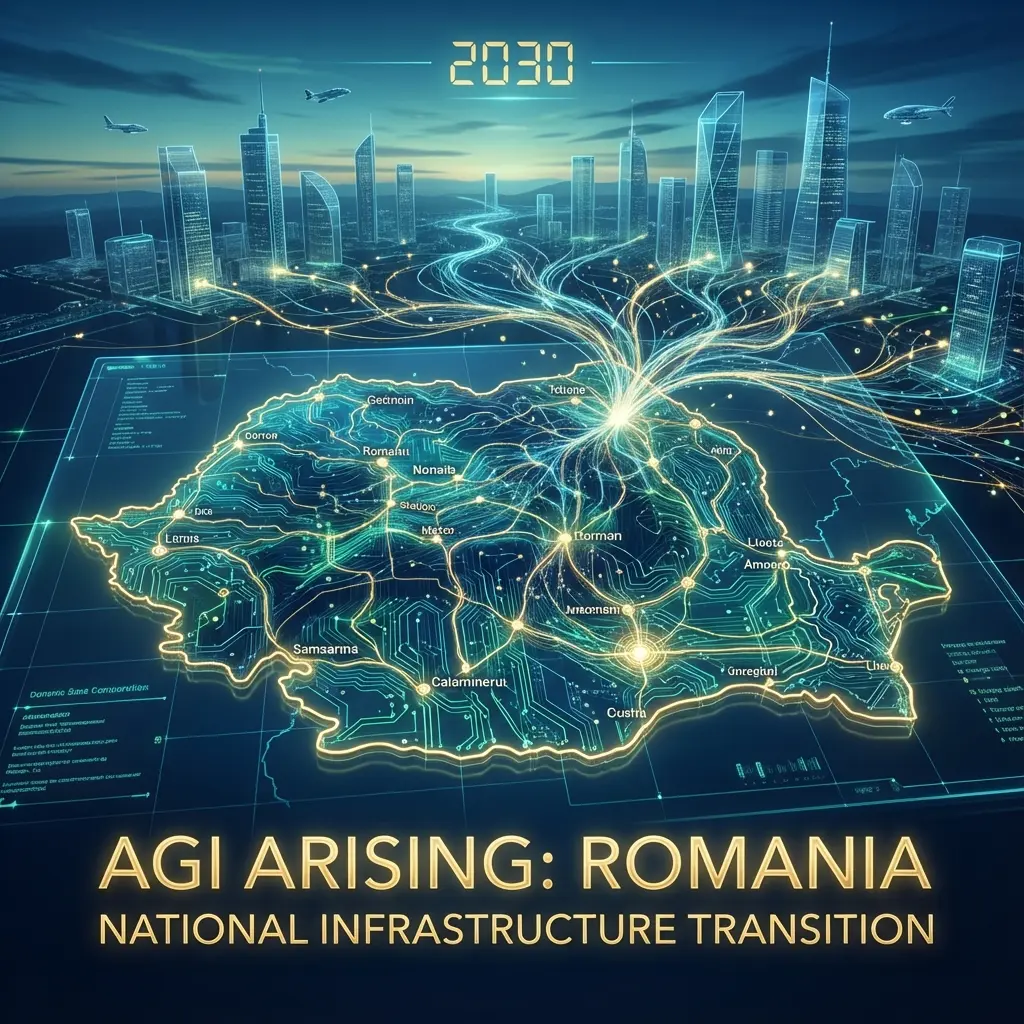
Introduction: The 2025 inflection point
In 2025, the global technology landscape is undergoing its deepest shift since the emergence of the internet. We are moving from narrow AI systems (ANI) toward a tangible AGI horizon - systems capable of human-level or superhuman cognitive flexibility.
This transition is no longer only academic debate. It is now a central driver of national economic strategy and large-scale corporate investment.
Romania is in a paradoxical but opportunity-rich position: despite delays in public-sector digital adoption, local innovation capacity is rising through critical infrastructure initiatives such as RO AI Factory and through internationally recognized startup ecosystems.
This report serves as a strategic resource for CreativDigital readers. It has two goals:
- Synthesize AGI status through global expert perspectives, including Demis Hassabis.
- Anchor these concepts in Romania's business and social reality.
Related reads: AI SEO Automation Guide 2025 | Cloud Computing Romania 2025 | AI Content Marketing Strategy
Chapter 1: Defining AGI and the Google DeepMind vision
1.1. ANI vs AGI vs ASI
Public discourse often blends these terms. A rigorous distinction is essential.
The dominant stage in 2024-2025 remains ANI (Artificial Narrow Intelligence). These systems are highly specialized and excellent at statistical pattern recognition in text, code, and images, but they lack broad causal understanding and cross-domain transfer.
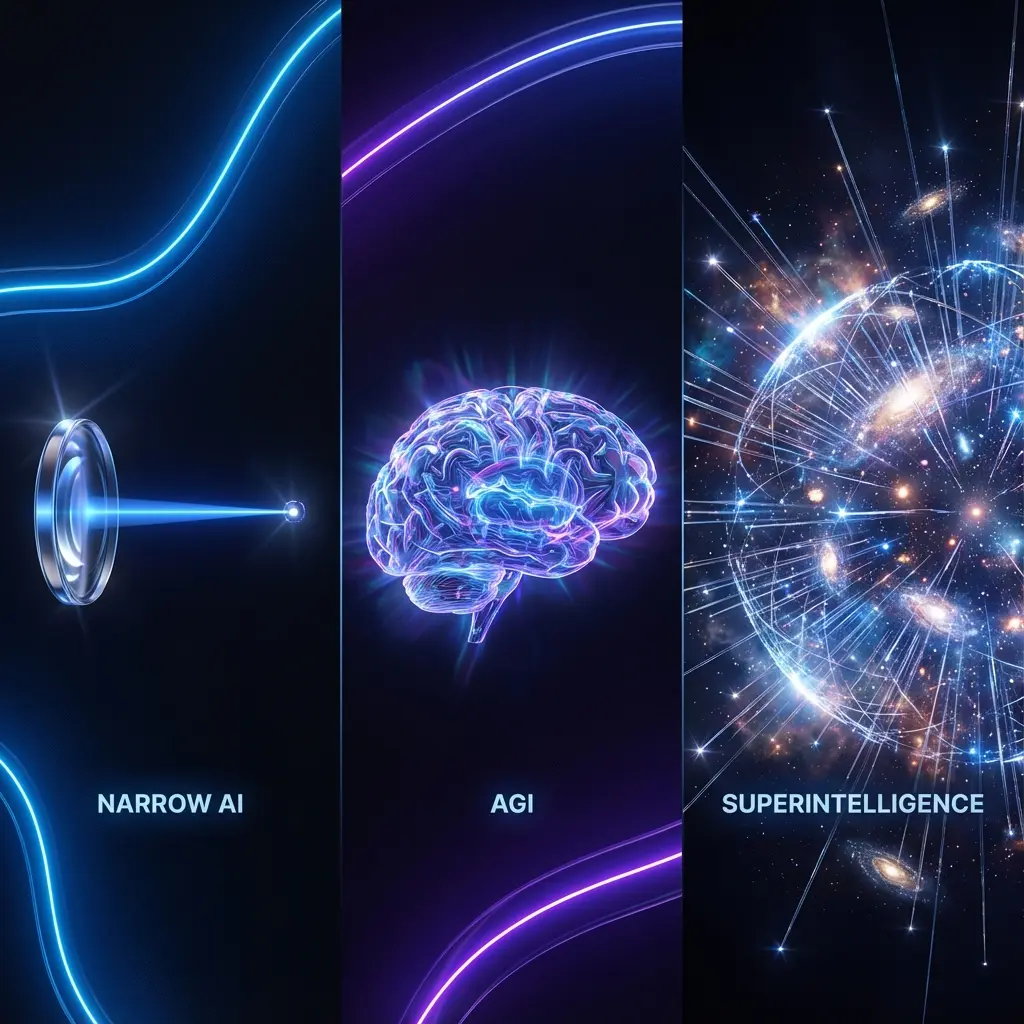
AGI (Artificial General Intelligence) is the ability to perform robustly across domains with generalized reasoning, creativity, planning, and problem-solving.
Demis Hassabis emphasizes that AGI is not about mastering one benchmark task. It is about consistent trans-domain intelligence.
Beyond AGI, ASI (Artificial Superintelligence) refers to systems exceeding top human capability across all domains. A key concern in current research is that AGI-to-ASI transition could be very rapid due to recursive self-improvement loops.
1.2. Demis Hassabis and the 2030 horizon
Hassabis is a central figure in AI due to both research leadership and scientific impact (including recognition linked to AlphaFold's breakthrough impact).
In 2025 statements and interviews, he estimated a meaningful probability that AGI could emerge around 2030. That timeline creates strategic urgency for governments and companies.
At the same time, he cautions against superficial marketing claims that current chatbot systems are already equivalent to broad expert cognition. Scaling compute alone is unlikely to be sufficient without deeper architectural breakthroughs.
1.3. Beyond language: why world models matter
A core weakness of current LLMs is hallucination risk. Hassabis and DeepMind argue for World Models as the next leap: systems grounded in causal structure and physical reality.
Projects such as advanced Gemini and simulation-driven research initiatives suggest movement toward systems that can anticipate consequences, reason over environments, and support scientific discovery.
| Characteristic | Current LLM Paradigm | AGI / World Model Paradigm |
|---|---|---|
| Learning basis | Statistical pattern learning | Causal + physical understanding |
| Reliability | Hallucination-prone in edge cases | Stronger factual/causal consistency |
| Creativity | Recombinational | Hypothesis generation and discovery |
| Primary use | Content and assistant tasks | Science, robotics, high-stakes planning |
| Examples | Generic chat systems | AlphaFold, simulation-first research systems |
Chapter 2: Romania in the AI equation - strategy, infrastructure, and contrasts
Romania faces a dual challenge: align with EU standards while capitalizing on local technical talent.
2.1. National AI Strategy (2024-2027)
Romania approved a national AI strategy framework for 2024-2027. This is more than formal compliance. It defines policy directions for education, infrastructure, innovation, and trusted AI governance.
A notable element is the involvement of security institutions in inter-ministerial processes, reflecting AI's dual role: economic engine and national security factor.
2.2. Flagship initiative: RO AI Factory and national supercomputing layer
One of the most significant developments is Romania's inclusion among EU countries hosting an AI Factory under EuroHPC.
The project, led by major national academic and research institutions, aims to provide a high-performance supercomputing foundation dedicated to AI training and applied research.

Strategic implications:
- Digital sovereignty: reduced dependency on external hyperscaler-only pipelines.
- SME access: stronger compute access for startups and small enterprises.
- Priority sectors: life sciences, cybersecurity, autonomous systems.
2.3. The Romanian digital paradox: talent vs adoption
Romania continues to show strong technical talent and globally relevant innovation, but uneven local digital adoption.
Recent EU-indexed patterns indicate lower public-sector digital service usage compared to EU average and low enterprise AI adoption relative to leading member states.
This creates a structural split: high-end innovation capacity on one side, slower broad economic digitization on the other.
Chapter 3: Innovation champions - startup and corporate ecosystem
Despite slower macro adoption, Romanian founders continue building globally competitive AI companies.

3.1. Druid AI and agentic transformation
Druid AI has become a high-visibility Romanian AI player in conversational and agentic enterprise solutions.
Its evolution from chatbot tooling to autonomous agent orchestration systems is strategically relevant for AGI-adjacent operational models.
Partnership traction with major enterprise ecosystems validates real deployment credibility.
3.2. FlowX.ai and legacy banking modernization
FlowX.ai addresses a core global bottleneck: modernization of legacy banking systems without full-stack replacement.
By combining AI and integration architecture, it shortens modernization cycles and reduces transformation risk for financial institutions.
3.3. Veridion and data intelligence
Veridion operates in a critical layer of the AI economy: high-quality, continuously refreshed business data.
As AI systems become data-quality constrained, this category becomes strategically essential for underwriting, procurement, and risk intelligence.
3.4. Integrators and cloud architecture layer
Romania's ecosystem also depends on integration specialists capable of connecting enterprise infrastructure, cloud platforms, MLOps pipelines, and AI services into production-grade systems.
This integration layer is essential to convert theoretical AI potential into operational value for companies.
| Company | Core Domain | Key Innovation | Funding/Status | Strategic Impact |
|---|---|---|---|---|
| Druid AI | Conversational / Agentic AI | Agents creating and orchestrating agents | Scale-stage growth | Enterprise cognitive automation |
| FlowX.ai | Banking modernization | AI-driven legacy-to-modern flow acceleration | Major growth stage | Financial services transformation |
| Veridion | Big Data intelligence | Real-time company data enrichment | Growth stage | Better decision-quality data foundations |
| UiPath | RPA / automation | AI-augmented process automation | Public company | Global automation leadership with Romanian roots |
| Cloud integration players | Cloud/AI implementation | Scalable AI deployment architecture | B2B integrator role | Practical AI adoption enablement |
Chapter 4: Economic impact - labor market and productivity
AI's impact is not only technical. It restructures labor and value chains.
4.1. Automation and skills shift
A meaningful share of existing tasks in Romania is expected to be automated by the mid-2030s. The dominant phenomenon is not pure job disappearance but job transformation.
Demand for advanced digital and AI-adjacent skills is rising rapidly. Organizations pay clear skill premiums for workers who can operate with AI systems effectively.
AI-exposed sectors show stronger productivity growth versus low-exposure sectors.
4.2. Sector shifts and business opportunity
In Romania, AI impact differs by industry. IT&C remains central, but demand is expanding into finance, operations, healthcare, and domain-specific automation.
Opportunity is moving from generic outsourcing toward strategic AI consulting and productized vertical solutions tailored to local operational realities.
Chapter 5: Security, ethics, and social resilience
As AI becomes pervasive, systemic risk expands. Romania's geopolitical position increases exposure to hybrid influence operations and cyber threats.
5.1. Deepfake-era cyber and information threats
Recent election cycles and post-election periods highlighted vulnerability to synthetic influence operations and disinformation amplification.
At the same time, AI-enhanced phishing and social engineering become more effective through localized language fluency.
5.2. Institutional response and defensive initiatives
Romania has launched advanced initiatives to strengthen SOC capabilities and improve incident response through AI-supported monitoring and detection.
The strategic direction is clear: defensive AI must evolve as quickly as offensive AI.
5.3. Education and digital hygiene
In synthetic media environments, digital literacy becomes a national resilience requirement.
Interest in AI education is rising, but formal educational supply still lags practical need. Public and private institutions must accelerate AI literacy beyond tool usage into verification, critical thinking, and manipulation detection.
Chapter 6: SEO and content strategy in the AGI era
For digital publishers, AGI-era search systems change SEO fundamentals.
6.1. E-E-A-T and human authority signals
Google quality systems increasingly prioritize Experience, Expertise, Authoritativeness, and Trust.
In technical domains like AGI, purely AI-generated content without real-world grounding is likely to underperform.
For strong performance, content should:
- demonstrate practical experience
- cite primary sources and official reports
- handle high-stakes topics with factual rigor
6.2. Romanian keyword intent patterns in 2025
Search behavior shows three strong clusters:
- Educational intent: users searching for courses and practical understanding.
- Tool intent: users seeking free and immediate AI utility.
- Local business intent: users seeking Romanian AI companies, projects, and implementation guidance.
6.3. Adapting to generative search layers
With AI overviews in search results, structure matters more:
- direct answers near section openings
- semantic headers
- clean table/list organization
- clear factual grounding
Romania in 2025 is at a defining moment. It is connected to Europe's strategic compute future through AI Factory and globally visible startups, while still needing to close broad digital adoption gaps.
Prepare your business for the AGI era
Digital transformation is no longer optional. Whether you are a startup or a traditional company, AI integration in business workflows becomes a decisive competitiveness factor.
CreativDigital can support with:
- AI and automation consulting
- Web and application development for AI-era operations
- SEO and content strategy aligned to AI-driven search
- Cloud architecture and infrastructure optimization
Request a free consultation to evaluate how your organization can accelerate AI adoption with measurable outcomes.
Source note: This report is based on publicly available information through December 2025, including policy documents, executive interviews, and market analyses from recognized institutions.
About the author
CreativDigital Team combines web engineering, SEO, and digital transformation expertise with over 15 years of practical experience. Our mission is to make advanced technology actionable for local and regional businesses.