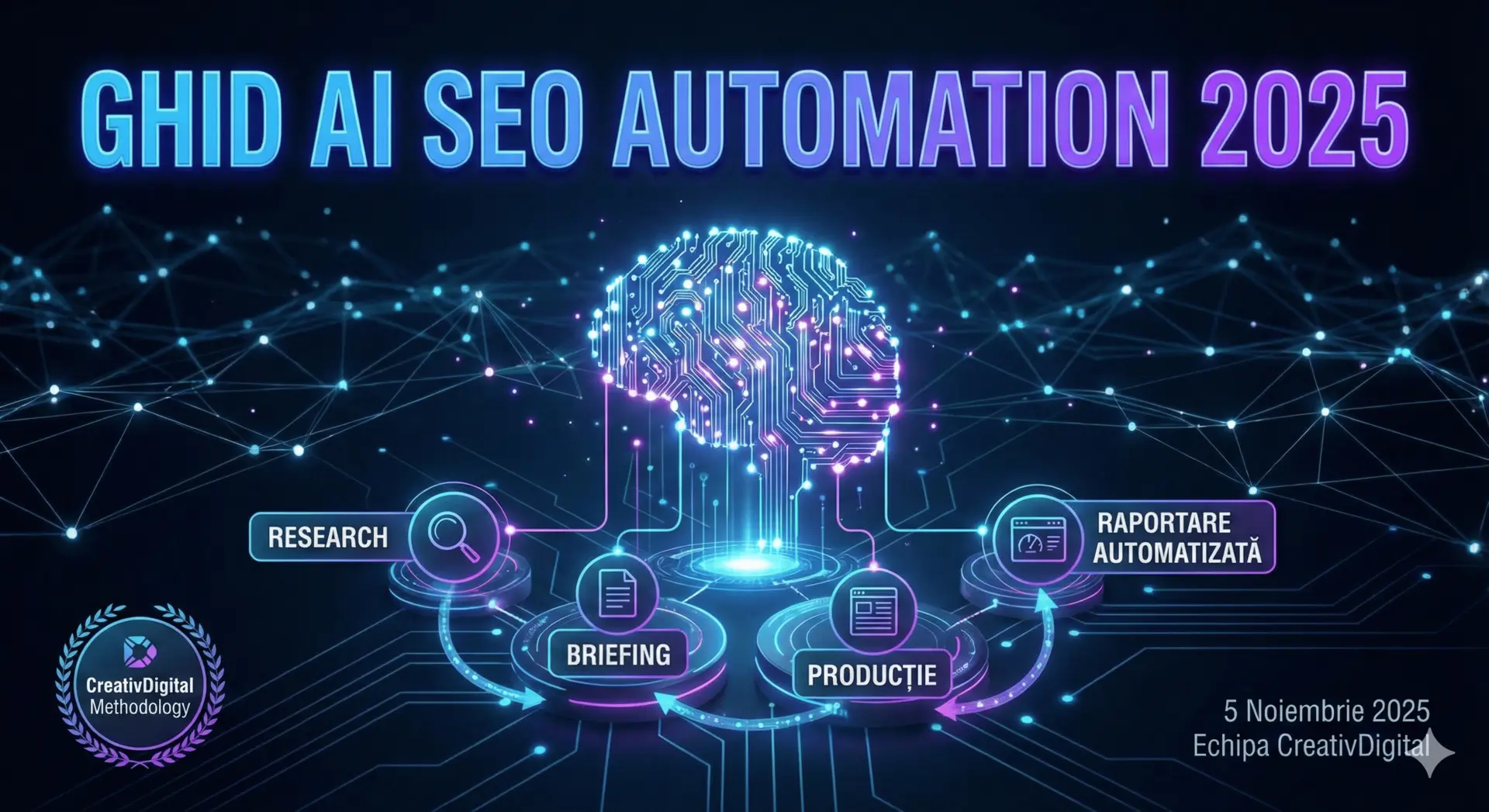
Traditional SEO programs face major challenges in 2026: massive data volumes, intense competition, and the need for personalization at scale. Artificial intelligence is no longer an experiment - it is the infrastructure that allows teams to produce high-quality content, automate repetitive tasks, and make decisions based on predictive analysis. This guide presents the complete framework we use at CreativDigital to integrate AI into every stage of the SEO process.
Executive Summary
- +220% increase in content productivity through automated research and briefing
- 70% time reduction for technical audits through AI-powered grouping and prioritization
- Predictive analytics enables traffic forecasts with 85% accuracy over 90 days
- E-E-A-T preserved through quality control processes and mandatory human involvement
1. AI SEO Framework in 5 Pillars
We approach SEO automation across five complementary dimensions:
- Automation (Task Replacement): automatic generation of repetitive tasks - meta descriptions, initial briefs, keyword clustering
- Augmentation (Human + AI): specialist assistance - SERP analysis, competitor intelligence, content gap identification
- Prediction (Forecasting): predictive models for traffic, emerging opportunity detection, and ranking risk analysis
- Orchestration (Workflow Integration): connecting SEO tools with AI through APIs and automated pipelines
- Governance (Quality & Ethics): controls for factual accuracy, E-E-A-T, transparency, and compliance with Google guidelines
2. AI Technology Stack for SEO
| Component | Tool / Example | Role in the Pipeline |
|---|---|---|
| LLM Core | GPT-4o, Claude 3.5 Sonnet, Llama 3.1 fine-tuned | Content generation, analysis, summarization |
| Workflow Orchestration | LangChain, Airflow, Make/Zapier | End-to-end automation and chaining |
| SERP Intelligence | SerpApi, DataForSEO, Bright Data | Fresh search result and competitor data |
| SEO Tools Integration | Ahrefs API, Semrush API, Screaming Frog Cloud | Keyword, backlink, and crawl data collection |
| Data Warehouse | BigQuery, Snowflake, ClickHouse | Unifying SEO + Analytics + CRM data |
| Optimization Tools | Surfer SEO API, Clearscope, NeuronWriter | Content scoring and on-page recommendations |
| Quality Control | GPT-4 fine-tuned, Fact-checking APIs | Factual verification and E-E-A-T compliance |
3. Automated Research & Discovery
The first phase combines existing data with artificial intelligence to identify opportunities.
3.1. Multi-Source Data Consolidation
- Google Search Console: queries with high impressions but low CTR
- Ahrefs/Semrush: keyword gap analysis against top 3 competitors
- Customer data: frequent questions from support, sales calls, and CRM notes
- Social listening: Reddit, LinkedIn, and niche forums for real pain points
3.2. Topic Clustering with LLMs
We use NLP models to group keywords into semantic clusters:
- Export relevant keywords (5,000-50,000 terms)
- Create vector embeddings (OpenAI Ada, Cohere) for each keyword
- Apply algorithmic clustering (K-means, DBSCAN) to identify content pillars
- Have the LLM summarize each cluster and propose article titles
3.3. Persona & Intent Mapping
AI analyzes behavioral data and generates automated persona profiles:
- User segmentation in Analytics based on behavior
- Support conversation analysis to identify needs
- Intent mapping (informational, navigational, commercial, transactional) per topic
4. Intelligent Content Briefing
Briefing is the biggest bottleneck in content operations. AI cuts time from 3-4 hours to 15-20 minutes.
4.1. Automated Brief Template
Our standard GPT-4o prompt includes:
Analyze the top 10 SERP results for keyword "[KEYWORD]" and generate a structured JSON content brief with:
1. Target keyword + semantic variants (LSI)
2. Dominant search intent (informational/commercial/transactional)
3. Recommended H2/H3 structure based on competitive headings
4. Frequently asked questions (from People Also Ask + Related Searches)
5. Key entities and concepts to cover
6. Recommended tone of voice
7. Target word count
8. Authority sources for citations
9. Internal linking opportunities
10. Recommended CTA
4.2. SERP Analysis Layer
We implement an additional analysis layer:
- Heading extraction: all H2/H3/H4 from top 10 results
- Content gaps: topics covered by competitors but missing from the brief
- Media analysis: image, video, and infographic formats used
- Schema markup check: what schema types competitors implement
5. AI-First Content Production
We create content in four layers, each with human validation.
5.1. Initial Draft (80% AI)
- The LLM receives the JSON brief + reference sources
- It generates a full draft with approved structure
- It includes placeholders for sections that require human expertise
5.2. Fact-Checking & Expert Input (100% Human)
- Specialists verify all factual statements
- They add unique perspectives, case studies, and proprietary data
- They insert author expertise and E-E-A-T signals
5.3. Optimization Layer (AI + Human)
We integrate content scoring tools:
- Surfer SEO / Clearscope for on-page analysis
- Automated recommendations for keyword density and LSI terms
- Readability scoring (Flesch, Hemingway)
- Internal linking suggestions based on topic clusters
5.4. Quality Assurance (AI + Human)
| Criterion | Validation | Tool |
|---|---|---|
| Factual accuracy | Cross-reference with trusted sources | GPT-4 + fact-check APIs |
| E-E-A-T | Author bio, citations, expertise signals | Manual review |
| Originality | Plagiarism check, AI detection | Copyscape, Originality.AI |
| On-page SEO | Meta, headings, schema | Screaming Frog, Surfer |
6. Automated Technical Audits
AI transforms technical SEO audits from unstructured lists into actionable playbooks.
6.1. Crawl + AI Grouping
- Full crawl (Screaming Frog, Sitebulb, Lumar)
- Export issues into CSV (duplicate titles, missing canonicals, slow pages)
- LLM groups problems by type and severity
- Generates clear descriptions and prescriptive recommendations
6.2. Impact-Based Prioritization
Our prioritization model combines:
- Traffic potential: traffic volume on affected pages
- Conversion potential: historical conversion rate
- Difficulty score: estimated remediation effort (dev hours)
- Business priority: alignment with business goals
6.3. Backlog Automation
Direct integration with project management tools:
- Tasks created automatically in Jira/Linear/Asana
- Assigned to relevant teams (Dev, Content, SEO)
- Suggested SLAs based on severity
- Dependencies mapped automatically
7. Predictive Analytics & Forecasting
We use ML models to anticipate SEO decision impact.
7.1. Traffic Forecasting
- Input data: 12-24 months of organic traffic history, seasonality, Google updates
- Features: rankings per keyword, CTR, search volume, competitor data
- Model: ARIMA + XGBoost for 90-day forecasting
- Output: estimated traffic, confidence intervals, and optimistic/realistic/pessimistic scenarios
7.2. Opportunity Detection
AI detects emerging opportunities:
- Rising-trend keywords (Google Trends API + Ahrefs data)
- High SERP volatility as an opportunity to win featured snippets
- Competitors losing rankings as traffic acquisition opportunities
7.3. Risk Monitoring
- Pattern detection for ranking declines (early warning system)
- Automatic alerting when rankings fall below threshold
- Analysis of Google updates and their site impact
8. Governance, Ethics, and E-E-A-T
Google penalizes AI-generated content without human involvement. Our framework ensures compliance.
8.1. Technical Guardrails
- Fact-checking layer: automated validation + manual review
- Source attribution: each statement must have a cited source
- Plagiarism detection: full scan before publication
- AI watermarking: disclosure where AI contributed significantly
8.2. Mandatory Human-in-the-Loop
| Stage | Human Role | AI Role |
|---|---|---|
| Research | Topic validation, prioritization | Clustering, data analysis |
| Briefing | Final approval, adjustments | Automated brief generation |
| Draft | Expert input, fact-check | 80% initial draft |
| Optimization | SEO change approval | Automated recommendations |
| Publishing | Final review, approval | Scheduling, distribution |
8.3. E-E-A-T Signals
Each AI-assisted article must include:
- Declared author: identifiable expert with bio and credentials
- Citations: minimum 5 authority sources for informational content
- Original research: proprietary data, case studies, unique insights
- Transparency: explicit mention of where AI was used
9. Case Study - B2B SaaS Marketing Platform
Challenge: Massive content backlog (200+ planned articles), small team (2 writers), no clear prioritization.
Implemented solution:
- AI workflows for research and briefing (60% of briefs generated automatically)
- Content factory with AI drafts + expert review + optimization
- Predictive model for topic prioritization by traffic potential
- Quality control with dual review (AI fact-check + human approval)
Results after 6 months:
- Productivity: average article time reduced from 2.5 days to 6 hours
- Volume: from 8 articles/month to 45 articles/month
- Quality maintained: stable E-E-A-T score (manual audit)
- Business impact: +82% organic traffic, +47% qualified MQL leads
- Cost efficiency: -35% cost per article vs external agency
10. Implementation Roadmap (90 Days)
Phase 1: Diagnosis & Setup (Days 1-14)
- Audit current SEO maturity and identify bottlenecks
- Map available tools and data
- Define priority use cases (content, audit, reporting)
- Set up infrastructure (API access, data warehouse, orchestration)
Phase 2: Pilot & Validation (Days 15-45)
- Implement 1-2 pilot workflows (for example: automated briefing + AI audit)
- Train team on tools and processes
- Develop quality control guidelines
- A/B testing: AI-assisted content vs traditional content
Phase 3: Scale & Integrate (Days 46-75)
- Roll out validated workflows across the full team
- Integrate with CRM, marketing automation, and product analytics
- Automate reporting and predictive dashboards
- Fine-tune models on company data
Phase 4: Continuous Optimization (Days 76-90 and beyond)
- Retrain models with new data
- Update prompts and templates
- Expand into new use cases (localization, voice search, video SEO)
- Knowledge sharing and documentation
11. KPIs for Measuring Success
| Dimension | Metric | Target |
|---|---|---|
| Velocity | Articles/briefs generated per month | +150% vs baseline |
| Efficiency | Hours saved per task | 60% time reduction |
| Quality | E-E-A-T score (manual audit) | Maintained or improved |
| Quality | Revisions needed post-draft | < 2 iterations/article |
| Impact | Incremental organic traffic | +50% in 6 months |
| Impact | Share of Voice in SERP | +30% vs competitors |
| Impact | Leads attributed to content | +40% conversion rate |
| Cost | Cost per published article | -40% vs outsourcing |
12. Recommended Tool Stack (2026)
LLM & AI Platforms
- OpenAI GPT-4o: content generation, analysis, embeddings
- Anthropic Claude 3.5: long-context analysis, fact-checking
- Google Gemini: multimodal (text + images), Google Workspace integration
- Perplexity API: research-assisted generation with sources
Workflow Orchestration
- LangChain: prompt chaining and complex agents
- Apache Airflow: orchestration of data-intensive pipelines
- Make (Integromat): no-code automation for fast integrations
SEO Data & Intelligence
- Ahrefs API: keyword research, backlinks, competitive intelligence
- Semrush API: position tracking, SERP features, content analyzer
- DataForSEO: cost-effective SERP data at scale
- Google Search Console API: performance data, index coverage
Content Optimization
- Surfer SEO: content editor, SERP analyzer, auditing
- Clearscope: content optimization and competitive analysis
- Frase / MarketMuse: content brief generation and topic modeling
Conclusion
Integrating AI into SEO does not mean replacing specialists. It means amplifying their ability to deliver results at scale. This framework combines repetitive task automation with human judgment for strategic decisions, while preserving quality and compliance with Google's E-E-A-T expectations.
Next steps:
- Identify current bottlenecks in your SEO process
- Select 1-2 pilot use cases (we recommend briefing + technical audit)
- Implement with technical support and team training
- Measure impact and scale gradually
Want to become AI-first in SEO? CreativDigital can help you build custom workflows, fine-tune models on your data, and implement robust quality controls — see our SEO & digital marketing service and AI agent automation. Book a consultation to discuss your specific strategy.