OpenAI has dropped one of the most significant enterprise AI announcements in years: Frontier.
This is not just another ChatGPT update or a faster language model. It is a new platform architecture built to design, manage, and integrate AI Agents directly into enterprise operating systems.
Until now, many teams treated AI as a passive copilot. Frontier proposes a different model: AI as an active agent with delegated autonomy.
From chatbot to AI agent: the paradigm shift
To understand Frontier's impact, we need to separate chatbot behavior from agent behavior.
A standard chatbot is reactive: question in, response out. It does not maintain deep operational memory, and it cannot take accountable system actions on your behalf.
Frontier-style AI agents are different:
- Agency: they can receive broad goals (for example, "analyze Q3 sales decline") and plan execution pathways.
- Memory + context: they can operate with organizational context, policy constraints, and historical workflow signals.
- Tool use: they can interact with operational systems (CRM, ticketing, analytics, workflow engines).
Frontier architecture: enterprise cognitive layer
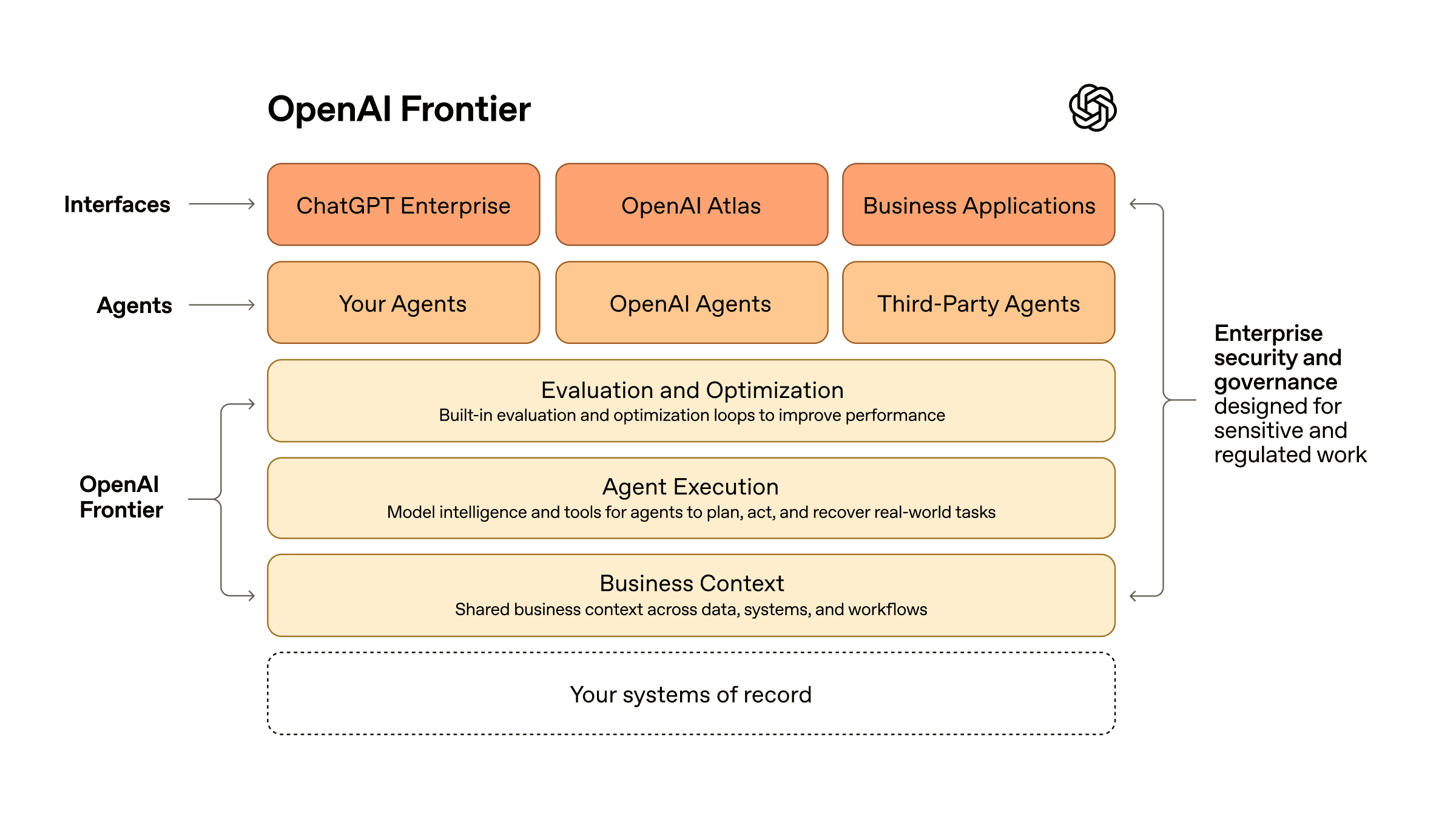
Frontier aims to connect AI cognition with core company systems.
1. Deep integration
Frontier is designed to integrate into system infrastructure, not sit above it. Typical targets include CRM (Salesforce/HubSpot), data platforms (Snowflake/Databricks), support systems (Zendesk/Jira), and internal tooling.
2. Reasoning and execution engine
These agents are not limited to text prediction. They can:
- Plan: decompose complex tasks.
- Code: generate and execute scripts for data handling and automation.
- Operate UI workflows: interact with legacy interfaces where APIs are limited.
3. Identity, permissions, and guardrails
A critical enterprise innovation is explicit identity and policy control.
- Granular permissions: HR agent does not inherit finance-level access.
- Audit trail: each AI action is logged with traceability.
- Guardrails: policies limit risky outputs and high-impact actions without approval.
4. Continuous learning loops
Like human teams, agents improve from corrections and feedback. Adjustments are incorporated into future behavior patterns when governance policies allow adaptation.
Implementation model: why OpenAI mirrors forward-deployed engineering
A notable launch signal is implementation strategy. Rather than simple self-serve onboarding, OpenAI appears to emphasize deeper integration support, similar to forward-deployed enterprise engineering models.
Why this approach?
- Integration complexity: legacy enterprise stack integration is highly custom.
- Trust/security: large organizations require deployment guarantees beyond generic API use.
- Operational lock-in: once core processes are deeply integrated, switching costs increase.
This strongly suggests Frontier is an enterprise-first product tier.
Case-style outcomes: where productivity gains appear
Early outcomes discussed around agentic deployment models show nonlinear gains in certain workflows.
Manufacturing
Scenario: supply planning previously required multi-week coordination. With agents: supplier coordination, inventory checks, and scenario simulation become partially automated. Outcome pattern: planning cycles compress from weeks to days.
Investment/advisory operations
Scenario: consultants spend large time blocks on account research and CRM admin. With agents: briefing prep and post-call CRM updates become automated. Outcome pattern: more time available for high-value client interaction.
Energy operations
Scenario: grid optimization and predictive maintenance require high-frequency signal analysis. With agents: real-time sensor analysis and field workflow coordination improve response speed. Outcome pattern: even small efficiency gains can create large annual value at infrastructure scale.
The SaaS tension: efficiency vs seat-based software economics
A major strategic side effect is pressure on classic SaaS seat pricing models.
If agentic workflows let teams operate with fewer manual steps and fewer human operators for certain processes, enterprise buyers will reassess software seat counts and UI-heavy tool value.
Agents often prefer API-level interactions. This changes where software value is captured: from interface layers toward data quality, orchestration, and governance layers.
What changes for human teams?
If agents increasingly handle analysis, execution, and admin tasks, human roles evolve.
- From operator to architect: people define goals, constraints, and quality thresholds.
- Higher value in relationships and judgment: empathy, negotiation, strategy, and accountability remain critical.
- New capability: managing fleets of digital agents becomes a core competency.
Conclusion: are you ready for the agent era?
Frontier signals formal transition into AI-agent operations. The key question is no longer if agent systems enter business workflows, but how quickly and how deeply.
Early adopters can gain structural advantage through faster execution and lower coordination friction.
Want to prepare your organization for this shift?
At CreativDigital, we help teams design practical AI workflow adoption roadmaps. Even if full Frontier deployment is enterprise-grade today, agent principles can be implemented at any scale — that is exactly what our autonomous AI agents service does for SMEs, not just enterprises. Contact us to design your first production-ready AI workflows.