
MiniMax M2.5 in Cline: Built for a World Where Agents Work Together
MiniMax has just launched M2.5. It is now available in Cline across VS Code, JetBrains, Zed, Neovim, Emacs, and the Cline CLI. MiniMax is offering M2.5 for free for a limited period, so there is no barrier to testing it.
We spent time testing and comparing it against major models. Here is what we found and how it can help with practical projects.
Who is MiniMax? (Shanghai's "AI Tiger")
Before going technical, it helps to understand the company behind the model. MiniMax is a Shanghai startup founded by former SenseTime employees. It rapidly reached unicorn status and is widely seen as one of China's "Four AI Tigers."
This is not their first successful product. You may already know Hailuo AI (video and music generation platform) or the video-01 model, often compared to Sora. With M2.5, MiniMax is entering coding and productivity aggressively, targeting developers and companies that need affordable automation.
What is new in M2.5
M2.5 builds on M2.1 coding strengths and pushes into multi-agent design. MiniMax calls this an "agent-verse" approach. While M2.1 was a strong single-agent coding model, M2.5 is trained to work with other agents, switch context across software environments, and coordinate parallel tasks without losing thread.
Another major addition is workspace fluency. MiniMax trained M2.5 in real office environments, not only codebases. It can handle Excel, Word, and PowerPoint workflows natively, enabling smoother transitions between coding and operational documents.
Performance metrics:
- 100 tokens/second throughput, roughly 3x faster than Opus in many practical scenarios.
- USD 0.30 / 1M input tokens, and around USD 0.06 / 1M with heavy caching patterns.
- Runs with 10B active parameters, one of the smallest footprints in its class.
Comparative analysis: M2.5 vs Claude 3.5 Sonnet vs GPT-4o
For developers and founders, model choice depends on budget and task complexity.
| Feature | MiniMax M2.5 | Claude 3.5 Sonnet | GPT-4o |
|---|---|---|---|
| Core strength | Speed & low cost | Complex reasoning & coding quality | Multimodal versatility |
| Speed (tokens/sec) | ~100 (very fast) | ~50 | ~80 |
| Cost | Very low | Medium | Medium-high |
| Context window | ~200k | 200k | 128k |
| Ideal role | Autonomous agents, bulk execution | Architecture, deep debugging | Interactive assistant, mixed tasks |
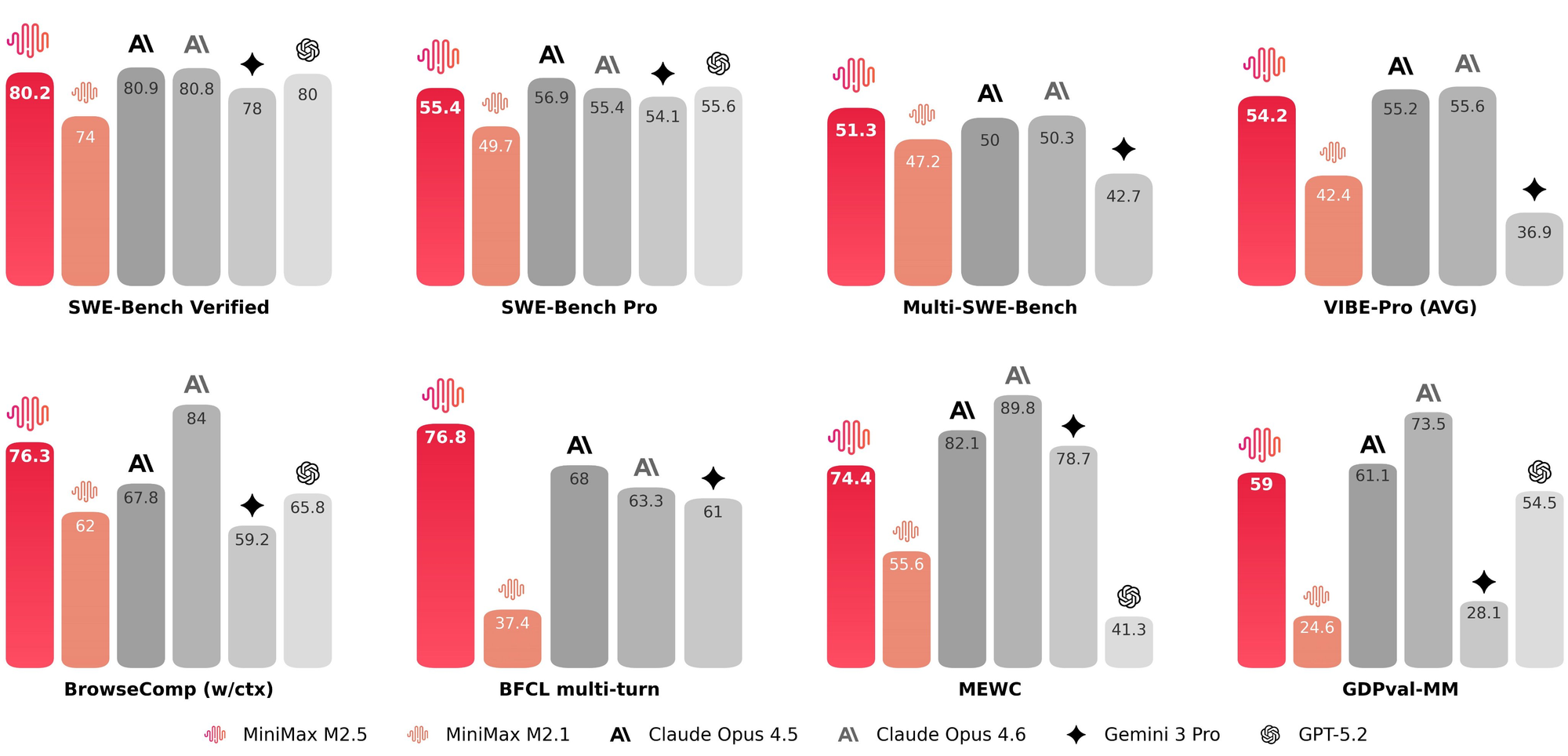
M2.5 beats Opus 4.6 on SWE-Bench Pro (55.4 vs 53.4) and edges ahead on Multi-SWE-Bench (51.3 vs 50.3). For highly nuanced architectural reasoning, Claude 3.5 Sonnet still remains one of the strongest choices.
💡 Pro Tip: > Architecture tip: use Claude 3.5 Sonnet or Claude Opus 4.6 for initial architecture and planning, then run MiniMax M2.5 for implementation, documentation, and test generation. This "high intelligence + high speed" combination works very well.
How it performs in Cline
Subagents
The latest Cline Subagents release allows multiple agents to run different parts of a task in parallel. M2.5 was trained for this exact setup, and the difference is visible in real execution.
The model keeps context clean while other agents run in parallel. It can move between coding, test review, and documentation work without context collisions.
CLI behavior
This is where M2.5 stands out most. 100 tokens/sec is only part of the story. The bigger difference is token efficiency: MiniMax optimized decision flow so M2.5 spends less time over-deliberating clear steps.
With auto-approval enabled in CLI workflows, execution rhythm changes significantly. You assign a task, it decomposes, executes, and iterates quickly.
Why it matters for teams in Romania
For startups and agencies, MiniMax M2.5 is attractive for two reasons:
- Lower cost: significantly cheaper than many frontier US models, making experimentation and automation workflows easier to sustain.
- Office automation: native Excel/Word capabilities make it useful for admin-heavy teams working in Romanian and English.
FAQ
Is MiniMax M2.5 free?
At the moment, MiniMax offers free or very low-cost access to accelerate adoption. In Cline, you can use it with your own API key.
How does it compare with DeepSeek?
Both are high-performance, low-cost Chinese models. DeepSeek V3 is strong for pure coding. MiniMax M2.5 appears to have an advantage in multi-agent coordination and office-tool behavior.
Can I use M2.5 with sensitive GDPR data?
Because the model is hosted by a Chinese provider, apply strict caution with personal or highly confidential EU client data. For public/open-source workloads it is very useful. For sensitive enterprise workloads, EU/US hosted enterprise setups remain safer from a compliance perspective — if you want AI automation built correctly on sensitive data, see how we approach this in our autonomous AI agents service.
How to use it
Select minimax-m2-5 from the model selector in Cline and authenticate with your MiniMax API key.
minimax-m2-5
In extension: available in VS Code, JetBrains, Zed, Neovim, and Emacs. In CLI: update to the latest Cline CLI and run multi-agent workflows with auto-approval to maximize speed gains.
Share your results on Discord or Reddit.